Telegram








An error in an already filed individual entrepreneur tax return can be corrected at any time — the law does not limit the number of corrections. The key is to correctly determine which document to file: a new reporting return or an amended return.
How to File an Amended Tax Return
What to Do If You Find an Error
The main rule is not to ignore the error. In most cases, correcting it takes 10–20 minutes if you correctly identify the type of document from the start.
The general procedure is as follows:
- Check whether the filing deadline for the reporting period containing the error has passed.
- Choose the type of tax return: “New Reporting” or “Amended.”
- Make sure the corrected income does not exceed the limit for your tax group.
- Prepare a tax return with the correct figures for the entire reporting period.
- If an underpayment has occurred, pay it before submitting the amendment.
This procedure applies regardless of the individual entrepreneur’s tax group or the type of error.
New Reporting or Amended?
The choice of tax return type depends on only one factor — whether the filing deadline for the reporting period containing the error has passed.
| New Reporting | Amended | |
| When it is filed | Before the reporting deadline | After the deadline has passed |
| Correction section | Not completed | Completed |
| Penalties | None | In peacetime — 3% in case of an underpayment; during martial law — none |
| Number of filings | Unlimited until the deadline | Unlimited within the statute of limitations |
The statute of limitations for filing an amended tax return is 1,095 days (Article 102 of the Tax Code of Ukraine). As of August 2026, this is the period to use as a general reference in most situations.
There is another way to correct an error — through the current tax return for the next reporting period. However, in peacetime, this involves a self-assessed penalty of 5% of the amount understated, so entrepreneurs almost always choose to file a separate amended return.
What Errors Can Be Corrected?
An individual entrepreneur most commonly uses an amended tax return to correct:ть:
- undeclared income;
- an incorrect unified tax amount;
- errors in the military levy;
- an incorrectly completed Appendix 1 (SSC);
- errors in taxpayer details — business activity codes (KVED), number of employees, etc.;
- an incorrect reporting period.
Particular attention should be paid to group income limits. If the annual income exceeds the group limit after the correction, a 15% unified tax is charged on the excess amount. This is especially critical for Groups 1 and 2: entrepreneurs often add “forgotten” income but fail to check whether this has resulted in exceeding the income limit.
Why Additional Income Does Not Always Change the Tax Amount
For Groups 1 and 2, the unified tax and military levy are fixed and do not depend on income as long as the income limit is not exceeded. Therefore, if you discover additional income but the limit is not exceeded, only the income amount in the tax return will change — the tax amounts will remain the same.
For Group 3, the calculation is different: the unified tax (5% or 3%) and military levy (1%) are calculated based on income, so any change in income automatically requires both amounts to be recalculated.
How to Complete an Amended Individual Entrepreneur Tax Return in the Electronic Taxpayer Account
Let’s look at the tax calculation and completion of an amended tax return using an example.
An individual entrepreneur under Group 3 (5% rate) discovers that they failed to include UAH 10,000 of income received in the previous year.

Step 1. Calculate the Figures
| Indicator | Original | Amended | Difference |
| Income | UAH 100,000 | UAH 110 000 | UAH +10 000 |
| Unified tax 5% | UAH 5 000 | UAH 5 500 | UAH +500 |
| Military levy 1% | UAH 1 000 | UAH 1 100 | UAH +100 |
In the correction section, you show the UAH 600 underpayment (UAH 500 unified tax + UAH 100 military levy). This amount must be paid before submitting the amended tax return.

Step 2. Complete the Amended Tax Return
This procedure applies to completing the tax return in the State Tax Service’s Electronic Taxpayer Account, on paper, or in other services where you enter the data manually.
- Select the «Amended» type.
- Specify the periods:
Line 2 — the current filing period.
Line 3 — the period being corrected. - Enter the correct figures. Repeat the correct income, unified tax, military levy, and other figures for the entire period on a cumulative basis.
Important: do not enter only the amount of the error. Enter the final correct figures. - Complete the correction section. This section compares the data from the previous tax return with the correct data in the amended return, after which the increase or decrease in the tax liability is calculated automatically.
- Add the required appendices. If the error concerns SSC, submit the amended Appendix 1 for an individual entrepreneur. If the SSC amount does not change, you do not need to add it again.
The filing is considered complete only after you receive Receipt No. 2 with the status «Accepted»
How to File an Amended Tax Return Through Vchasno.Zvit
If you want to file your tax return faster and avoid manual data entry, use Vchasno.Zvit:
- Create the current unified tax return form.
- Select the “Amended” type.
Specify the current period and the period being corrected. - Enter the amounts, and the service will help with the calculations.
- Add Appendix 1 if necessary.
- Run the desk audit (an automatic check of the correctness of the entered data).
- Sign the return with a qualified electronic signature (QES) and submit it.
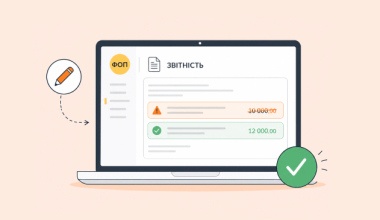
In Vchasno.Zvit, you can compare the original and amended tax returns on a single screen, which significantly simplifies the process.

Vchasno.Zvit — manage your sole proprietorship in one place!
Track deadlines, prepare tax returns, and keep a history of your filings all in one place.
Try Vchasno.ZvitSpecial Cases
📌 Tax Underpayment
If a correction results in an underpayment, follow this procedure:
- Calculate the underpayment separately for the unified tax and military levy.
- Check whether the 15% rate applies due to exceeding the group income limit.
- Pay the debt before submitting the amendment.
- Only then submit the tax return.
Do not submit an amendment “in advance” with the intention of paying later — this creates a risk of tax debt appearing on the taxpayer’s integrated account.
In peacetime, the taxpayer must additionally calculate and pay the self-assessed penalty — a penalty for incorrect reporting (Article 50 of the Tax Code of Ukraine):
- 3% — when filing a separate amended tax return;
- 5% — when correcting the error through a current tax return.
During martial law, Clause 69.38 of Subsection 10 of Section XX of the Tax Code of Ukraine exempts taxpayers from the self-assessed penalty and late-payment interest provided that they independently correct the error. In other words, as long as you follow the procedure, you currently pay only the underpaid amount — without a penalty or late-payment interest.
📌 Tax Overpayment
If the original tax return contained overstated income, the correction will result in an overpayment. It can be:
- credited toward future payments;
- refunded to the business account upon an application submitted through the Electronic Taxpayer Account.
📌 Errors in SSC Calculation
If the error concerns SSC, file an amended tax return together with an amended Appendix 1. In this case:
- the SSC amount and late-payment interest (0.1% for each day of delay) must be additionally assessed and paid independently before submitting the amendment;
- the penalty for an SSC error is not self-assessed.
📌 Military Levy
The correction procedure differs depending on the tax group:
- Groups 1–2 — the military levy is fixed, so recalculation is generally not required.
- Group 3 — any income correction requires the military levy to be recalculated (1% of income).
📌 Repeated Correction
An amended tax return can be filed repeatedly — there is no limit on the number of filings within the statute of limitations. If you find another error after the first correction, file a new amended tax return.
Important. The data from the previous amended tax return, rather than the original one, will be used as the basis for comparison. Keep this in mind when completing the correction section so that the difference is calculated correctly.
Common Mistakes Individual Entrepreneurs Make When Completing an Amended Tax Return
When preparing and filing an amended tax return, entrepreneurs most often make the following mistakes:
- They enter only the amount of the error instead of the final figures. You need to enter the full correct figures for the entire period on a cumulative basis.
- They do not check the group income limit after correcting income. This is especially relevant for Groups 1 and 2 — exceeding the limit results in a 15% tax on the excess amount.
- They file the tax return before paying the underpayment. This creates a risk of tax debt — pay first, then file.
- They confuse the tax return types. If the filing deadline has not yet passed, a new reporting return is required, not an amended one — and vice versa.
- They forget to submit Appendix 1 when the SSC amount changes or, conversely, submit it again unnecessarily when the SSC amount has not changed.
- When making a repeated correction, they compare the data with the original tax return, even though the previous amended return should be used as the basis.
Correcting errors in tax reporting does not have to be a stressful process. Vchasno.Zvit turns this task into a simple and straightforward procedure. Automated calculations and the ability to compare the original and amended tax returns on a single screen help minimize the risk of errors and save you time.