Telegram








Content
- Introduction
- Registering as an individual-entrepreneur — where to start?
- Step 1. Choose the KVED
- Step 2. Choose a group for an individual-entrepreneur
- Step 3. Choose a method for registering as a sole proprietor
- Step 4. What to do after registering as a sole proprietor
- Step 5. Open a bank account
- Step 6. Obtain a qualified electronic signature
- Step 7. When to Pay Taxes and File Reports
- Step 8. Register the RRO/PRRO if needed
- How long does it take to set up a sole proprietorship?
- How much does it cost to set up a sole proprietorship?
- Useful services for conducting business
An individual entrepreneur is the most popular form of business in Ukraine. According to data from the YouControl service, approximately 140,000 Ukrainians registered as FOPs in the first half of 2026.
In 2026, you can register an FOP for free online through the “Diya” portal or through a state registrar. Before submitting your application, you must select your KVED codes and tax system. After registration, you should verify your information in the registries, open a business bank account, and set up income tracking, tax payments, and reporting. We cover all the details in this article.
Registering as an individual-entrepreneur — where to start?
You can register as a sole proprietor starting at age 16. If a person between the ages of 16 and 18 has not yet been granted full legal capacity, notarized consent from their parents, adoptive parents, guardian, or the guardianship and custody authority is required for registration. He/she will pay taxes at the place of registration or at the officially registered place of residence.
IDPs from the temporarily occupied Ukrainian territories may register as an individual-entrepreneur at a different place of residence. First, they need to obtain a temporary registration document from the State Migration Service of Ukraine.
Documents required to open an individual-entrepreneur
The following documents are required to register as an individual-entrepreneur:
- passport;
- Registration number of the taxpayer’s registration card;
- an application for registration;
- a single tax application (for the simplified taxation system).
The application form for the registration of an individual-entrepreneur is approved by Order No. 3268/5 of the Ministry of Justice. You can download the template here.
To register as a sole proprietor online through “Diya,” you do not need to prepare separate copies of your passport and TIN—the information is automatically retrieved as you fill out the application.
Step 1. Choose the KVED
KVED is a classifier of types of economic activity. It can be found on the website of the State Statistics Committee. The codes are structured by economic sectors. An individual-entrepreneur has the right to carry out business activities only in accordance with the codes specified in his/her registration documents. To quickly find the code you need, you can use the online KVED search in Vchasno.Zvit —simply enter the name or description of the type of activity to get the corresponding code.
The tax authorities require individuals-entrepreneurs to enter KVED codes in the State Register and run their business according to them. Single taxpayers need to indicate the KVED in the register of single taxpayers.
The KVED codes must correspond to the sole proprietor’s actual business activities. For single-tax payers, it is important that the relevant type of activity be specified not only in the Unified State Register (USR) but also in the register of single-tax payers, if required by the rules for the relevant group. For example, for sole proprietors in Groups 1–2, income from activities not listed in the register of single tax payers is taxed at an increased rate of 15%.
The KVED affects the single tax rate for groups I and II. For these groups, the rate is set by local councils, and its amount depends on the type of activity the individual-entrepreneur is engaged in.
According to Art. 293.6 of the Tax Code of Ukraine, if an individual-entrepreneur works under several KVEDs at once, the maximum single tax rate for his group is used.
When you submit registration documents, you must specify which KVED will be the main one. It describes the main line of your business. This is the business activity that will be the source of the individual-entrepreneur’s major income.
An individual-entrepreneur can indicate only one main KVED. In paper documents, the KVED indicated first in the list is considered the main one.
Things to consider when choosing a KVED
Before registering as an individual-entrepreneur, you should think about all types of business activities and specify additional KVEDs. They can be added at any time. Also, an individual-entrepreneur can change KVEDs if he or she changes the field of activity or needs a specific code to obtain a license (for example, to sell alcohol, tobacco products, etc.).
The tax legislation does not prohibit doing business in several areas at once (such as, for example, trade and services), so the number of KVEDs that can be registered is unlimited. However, banking institutions may perceive a large number of unrelated KVEDs as a sign of a fictitious business and refuse to open an account. Unrelated KVEDs may also attract the attention of the tax authorities.
The current classifier may not include certain types of modern services. In such cases, the individual-entrepreneur should choose a KVED that is adjacent to his or her industry. For example, codes 63.99 “Provision of other information services” and 73.12 “Agency in advertising in the media” are appropriate for SMM specialists.
Step 2. Choose a group for an individual-entrepreneur
After choosing a KVED, you need to choose a taxation system — general or simplified (single tax).
The general system is used by large companies employing a large number of workers. The tax amount is determined by a percentage of the net profit for the month.
The simplified system is suitable for small businesses. Entrepreneurs who operate under this system pay a single tax (ST) — a fixed amount or a percentage of their income.
The Tax Code of Ukraine (TCU) defines four groups of single taxpayers (STP):
IEs of Group 1 are entrepreneurs without employees who are engaged in the retail trade in markets or the provision of household services to people. Their annual income must not exceed UAH 1.44 million per year. Partnerships with legal entities are prohibited.
IEs of Group 2 are small businesses with higher revenues than in the previous group. Entrepreneurs can be engaged in the production of food and non-food products, forestry and fishery, animal breeding, restaurant business, trading in markets and shops, providing household services, manufacturing goods, freelancing, etc. The number of employees is limited to 10 people. The maximum annual income is UAH 7.2 million per year. Group 2 individual entrepreneurs are allowed to cooperate and enter into agreements with legal entities.
IEs of Group 3 are entrepreneurs who can work independently or hire an unlimited number of employees. During a calendar year, their income is limited to amounts to UAH 10 091 049. They can cooperate with legal entities.
IEs of Group 4 are entrepreneurs engaged in agricultural activities. This category has special taxation systems and no maximum annual income limit. Group 4 IEs are allowed to cooperate with legal entities.
| Sole Proprietorship Group | Who is it for? | Maximum annual income | Employees | Who can be a client |
| 1 Group | Retail trade in markets; consumer services for the public | up to 1.44 million UAH | No | Only individuals |
| 2 Group | Retail, manufacturing, the restaurant industry, consumer services, freelance work, etc. | up to 7.2 million UAH | До 10 осіб | Individuals and sole proprietors under the simplified tax system |
| 3 Group | Sole proprietors who need more flexibility in the types of activities they can engage in and in scaling their operations | up to 10 million UAH | Без обмежень | Individuals and legal entities, sole proprietors |
| 4 Group | Individual entrepreneurs engaged in agricultural activities | There is no maximum income limit, but: the share of agricultural production for the previous year must be at least 75% of total income | No | Individuals and legal entities, sole proprietors |
Step 3. Choose a method for registering as a sole proprietor
Entrepreneurs can register IE online using the Diia service, go to an ASC or state registrar, or use the services of lawyers. Let’s consider each method.
How to register IE in the Diia service
The easiest way to open IE is online through the Diia service. For this, an entrepreneur needs a qualified electronic signature.
Registration is automatic and requires no involvement of the state registrar. The following steps are required:
- log in to your account in the Diia service;
- go to the “Services” menu — “Start a business”;
- click the “Open in 10 minutes” button;
- indicate the citizenship and registration address of the individual-entrepreneur;
- select the KVED from the list;
- choose a taxation system (general or simplified);
- specify contact details; confirm the completed application with an electronic signature.
It takes up to 2 business days to receive the results of the IE registration. During the period of martial law, registration of IEs with the tax authorities may require more time.
How to open an IE via ASC or state registrar
For offline registration, an entrepreneur needs to fill out an application for registration of IE and make an appointment at the ASC or with the state registrar at the place of registration.
The following documents are required for registration at the ASC:
- passport;
- original of the tax identification number;
- application for registration of IE (it can be filled in at the place of registration);
- if necessary, an application for switching to the simplified taxation system.
Within a day after submitting the documents, the entrepreneur will be able to get an extract from the Unified State Register. It can be obtained in the personal account of the Diia service.
If there is no ASC in the locality where the entrepreneur lives, he/she can contact an accredited state registrar. Registration of IEs follows the same procedure.
How to register IE with the help of lawyers
An individual-entrepreneur can also use the services of a law company — its employees will prepare all the necessary documents. The cost of such services will depend on the timeframe for registration.
Comparison of methods for registering an individual entrepreneur
| Diya | One-Stop Administrative Service Center / State Registrar | Contract Lawyers | |
| Format | Entirely online, on your own, without visiting government offices | In person, offline, at the place of residence; an appointment is required | Online or offline—a lawyer prepares the documents on behalf of the business owner |
| What you need | Digital Signature | Passport, original TIN, registration application | Power of attorney or necessary information for the lawyer |
| Involvement of the State Registrar | Not required — registration is automatic | In-person presence is required | The lawyer acts on behalf of the business owner |
| Processing time | Registration proceeds immediately | Extract from the Unified State Register—within 2–3 day | Depends on the company’s pricing plan; expedited service may be available |
| Price | Free | Free | For a fee; the price depends on the selected turnaround time |
| Who is it for? | For those who already have a digital signature and want to register on their own in just a few minutes | For those who do not have a digital signature or wish to consult with a registrar in person | For those who want to delegate this process |
Step 4. What to do after registering as a sole proprietor
After registering, you should verify that your information is up to date, set up a system for tracking income, figure out how to pay taxes, and, if necessary, set up payment processing and document management.
Check your entry in the Unified State Register. Make sure that your sole proprietor details, KVED codes, and place of residence are listed correctly.
Check your status as a single-tax payer. If you chose the simplified tax system during registration, verify that the tax authority has added you to the register of single-tax payers.
3. Open a business bank account.
4. Obtain a digital signature.
5. Set up income tracking, taxes, and reporting.
6. Register a cash register system (PRRO), if required.
7. Obtain licenses or permits, if required for your type of business.
Step 5. Open a bank account
At certain banks (PrivatBank, Monobank, Raiffeisen Bank), you can open a sole proprietor account online using the mobile app. You can also open an account at any bank branch.
According to Paragraph 69.4 of the Tax Code of Ukraine, expense transactions under the account can only be initiated after the bank receives a notification from the controlling authority that the account has been registered.
An individual-entrepreneur must notify the bank of his/her business status (clause 69.7 of the Tax Code). It is not necessary to notify the tax authorities when the account is opened.
Step 6. Obtain a qualified electronic signature
An entrepreneur needs a qualified electronic signature (KEP) to register as an individual-entrepreneur online. Having a qualified electronic signature, an entrepreneur can solve many issues related to e-commerce:
- register a PRRO;
- sign electronic documents;
- submit tax reports in electronic form, etc.

Get a QES for a year without a separate payment
In the "Premium" tariff "Vchasno.Zvit" the electronic signature "Vchasno.KEP" is included in the price for 1 year. Convenient if you plan to keep your individual entrepreneur's reports online.
Choose a tariffStep 7. When to Pay Taxes and File Reports
After registering as a sole proprietor, it is important not only to determine which taxes you need to pay but also to keep track of the deadlines for paying them and filing reports. These deadlines depend on the chosen tax system, the sole proprietor’s tax group, and other conditions.
To make sure you don’t miss an important date, use the tax calendar for sole proprietors in “Vchasno.Zvit.” There, you can check the current deadlines for paying taxes and filing reports.
Step 8. Register the RRO/PRRO if needed
According to the current legislation, an individual-entrepreneur must use an RRO/PRRO for all settlement transactions with clients. If an entrepreneur fails to comply with this rule, he or she will be fined by the tax authorities.
The optimal solution for online trading is PRRO from Vchasno.Kasa. On the marketplace, it can be combined with a cash register and issue electronic receipts to buyers. The entrepreneur sends them in a messenger, by e-mail or in another convenient way.
After registering Vchasno.Kasa, an individual entrepreneur can connect acquiring to it. This will allow you to accept non-cash payments and simplify settlements with customers.
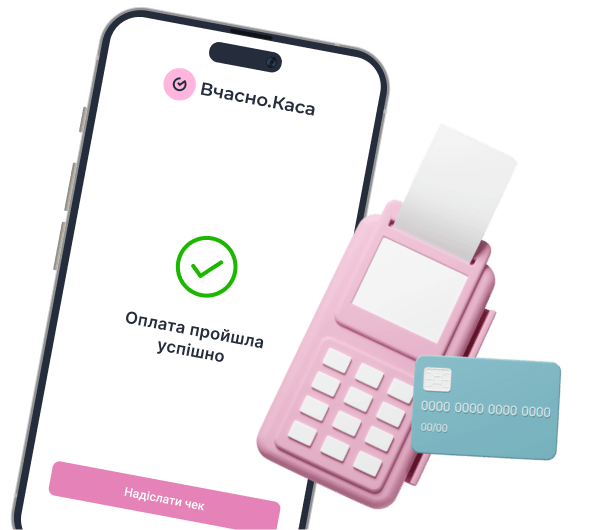
Vchasno.Kasa — the best PRRO for a start
Fiscalize and issue checks instantly — our PRRO transmits the necessary data to the Tax Office in real time, fully in accordance with the requirements of the law
PRRO Vchasno.KasaHow long does it take to set up a sole proprietorship?
It takes about 10 minutes to submit an application for automatic registration of a sole proprietorship through “Diya.” After signing the application, the automatic registration itself usually takes less than a minute.
After successful registration, information about the sole proprietorship should appear in the Unified State Register (USR). It is at this point that you can verify that your business status has been registered.
Registration as a single-tax payer is a separate process. If you selected the simplified taxation system when opening your sole proprietorship through “Diyu,” the application for registration as a single-tax payer is forwarded to the tax authority. Confirmation of this status occurs separately, so it may not appear at the same time as the entry for the sole proprietorship in the USR.
In other words, registering a sole proprietorship and registering as a single-tax payer are two separate processes. Your business status may already be registered, while your status as a single-tax payer is still being processed by the tax authority.
Therefore, if it is important to you not only to register your sole proprietorship but also to begin operating under the simplified tax system, you should check your status as a single-tax payer separately after registration.
How much does it cost to set up a sole proprietorship?
State registration of a sole proprietorship is free of charge. In other words, no state fee is charged for submitting an application to establish a sole proprietorship through “Diya.”
It is important to distinguish between three separate procedures:
- State registration of a sole proprietorship—the official entry of information about the entrepreneur into the Unified State Register. The registration itself is free of charge.
- Registration as a single-tax payer—a separate procedure for entrepreneurs who choose the simplified taxation system. It can be completed simultaneously with the registration of the sole proprietorship by submitting the appropriate application. The status of a single-tax payer is confirmed by the tax authority.
- Registration as a VAT payer is not required for all sole proprietors. It depends on the type of business activity and the volume of transactions, and in some cases may be voluntary. Registration as a VAT payer is a separate process from the state registration of a sole proprietorship.
At the same time, additional expenses may arise during the business startup process:
- business bank account—terms and service fees depend on the chosen bank;
- electronic signature—may be free or paid, depending on the provider and its terms;
- licenses—required only for certain types of activities and paid for in accordance with established requirements;
- PRRO — the cost depends on the solution chosen;
- accounting services or expert assistance — additional expenses at the entrepreneur’s discretion.
Useful services for conducting business
We have prepared a selection of useful services that allow an entrepreneur to automate and simplify work with documents and accepting payments:
- RozetkaPay payment service — the service helps the FOP to accept payments online (on the website or marketplace), as well as offline.
- platform for managing individual entrepreneurs Vchasno.Zvit — the service automatically generates tax reports, keeps records of income, and tracks payments. In the work area, you can work with several individual entrepreneurs at the same time.
- Vchasno.Kasa software is a service for the electronic recording of payment transactions that helps sole proprietors accept payments, generate and issue fiscal receipts, and manage cash register transactions online.
Vchasno.Zvit - management of sole proprietorship in one place!
Run your business, send reports to the tax authorities and manage bank accounts - all on a single platform.
Learn More