Viber
Viber
 Telegram








Most businesses perceive a receipt as a formality — a mandatory fiscal document issued after payment. But it is the receipt that is the final point of contact with the customer within the purchase. This is the moment when you can either end the interaction or reinforce the impression of the brand.
A branded receipt is a way to turn a standard document into a tool for loyalty, recognition, and additional communication. Because even such a small detail can work for the brand.
What is a branded check?
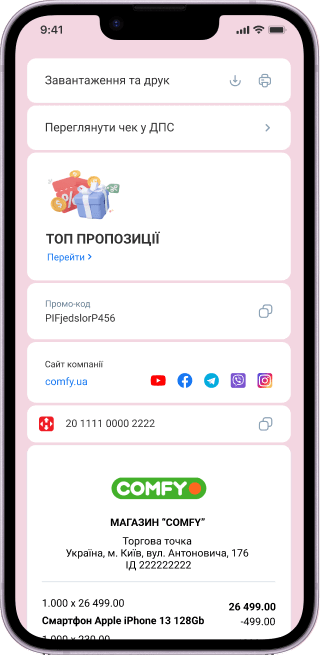 A branded receipt is a fiscal document designed in accordance with the company’s visual identity. It contains all the mandatory details required by law, while also featuring elements of corporate style and communication messages.
It is a fiscal receipt with a logo that does not look like a standard template, but is integrated into the overall brand system and maintains its integrity at every stage of interaction with the customer.
What a branded fiscal receipt may contain:
- company logo;
- brand colors;
- contact details;
- short message to the customer (thank you, invitation to return, discount);
- active link to the website or social networks;
- information about the loyalty program.
An electronic receipt with a logo can be fully adapted to the brand identity, with clickable elements added—links to the website, social media pages, product catalog, or feedback form.
Receipt personalization allows you to:
- increase brand awareness;
- strengthen customer trust;
- maintain contact with the customer after the purchase.
Thus, a receipt ceases to be merely a mandatory fiscal document and becomes a full-fledged communication tool.
Why businesses need branded receipts
In today’s business environment, companies that work with every point of contact with the customer are the ones that win. A brand is not only shaped by advertising or website design — it consists of dozens of details that together create a holistic impression.
1. Recognition
A receipt is not only a fiscal document, but also an additional point of contact with the customer. When it is designed in the corporate style, with a logo and distinctive visual elements, the brand becomes more cohesive and memorable.
2. Trust
A check designed in the corporate style reinforces the sense of consistency and transparency of the business. A neat, structured document with a logo and contact details signals to the customer that the company operates officially, responsibly, and pays attention to detail.
3. Repeat purchases
A receipt can be not only a confirmation of payment, but also a tool for customer retention. Through personalized messages or additional communication elements, it continues the interaction after the purchase.
For example, a receipt can:
- offer a discount on the next order;
- remind about the loyalty program or bonus account.
This approach transforms a standard document into a channel for marketing communication.
4. Additional sales
A branded receipt can also serve as a cross-selling tool. Thanks to its thoughtful design and text blocks, businesses can subtly recommend related products or services.
For example:
- A café may offer a special deal on dessert on your next visit.
- A beauty salon may offer professional care products.
- A store may offer accessories or an extended warranty on the purchased item.
Thus, the check becomes part of the strategy to increase the average check and customer LTV.
LTV (Lifetime Value) is an indicator that reflects the total revenue or profit that a business receives from a single customer throughout the entire period of interaction — from the first purchase to the end of cooperation.
5. Professional image
A strong brand is built on consistency. If the interior, website, packaging, and communication are all consistent in style, but the invoice looks standard and impersonal, it disrupts the integrity of the perception.
A branded receipt eliminates this gap. It maintains identity at the final stage of interaction, logically completes the customer journey, and demonstrates attention to detail. It is this consistency that shapes professional positioning and promotes long-term customer loyalty.
For which businesses is this particularly relevant?
Branded receipts can be useful for any company that works with retail customers. However, for certain segments, they are strategically important as an element of customer experience and a retention tool.
🔁 Businesses with high purchase frequency
This category includes beauty salons, clinics, dental clinics, barbershops, and other service companies where interaction with customers is regular.
In such niches, a receipt is not just a confirmation of payment, but a point of re-contact. It can:
- remind about the next visit;
- contain a personalized offer or bonus;
- provide contact details of a specialist;
- inform about the loyalty program.
For medical institutions, branded receipts further reinforce the sense of consistency, structured processes, and professionalism. This is important in an environment where trust is a key factor in choosing a provider.
🩷 Businesses with an emotional component to purchasing
Cafes, pastry shops, flower studios, jewelry stores, and gift shops work not only with goods but also with emotions. In this case, the receipt is an extension of the brand’s atmosphere.
For example:
- A café can add a short warm message, an invitation to leave a review, or a link to social media.
- A pastry shop can place a QR code on a page with new products or seasonal collections.
- A jewelry store can remind customers about warranty service or product care.
This approach helps turn a one-time purchase into a long-term relationship.
🌟 Businesses with a strong image
Boutiques, showrooms, and concept stores in the premium or mid-to-high segment are particularly sensitive to details. For them, the integrity of the visual and communication strategy at all levels is important.
A fiscal receipt without branding can clash with the overall positioning of the brand. A branded receipt, on the other hand, maintains a consistent style, emphasizes status, and demonstrates attention to detail — and it is precisely these details that shape the customer’s perception of the brand.
Which tariffs offer branded receipts?
The option to customize branded receipts is available in the Optimal and Maximum plans of the Vchasno.Kasa service.
You can customize receipts in line with your company’s corporate identity and marketing goals. In particular, you can place your company logo in the header of the receipt, which builds brand recognition at first glance and ensures a consistent customer experience.
You can also change the background color to match your company’s identity, allowing you to maintain a consistent visual concept across all points of contact with customers.
To strengthen your digital presence, you can add a link to your website and specify communication channels and social networks — phone, messengers, Instagram, or Facebook. This simplifies re-contact with customers and encourages subscriptions.
The receipt can also serve a marketing function: you can place top offers, current promotions, or special conditions on it. Additionally, there is an option to generate a promo code for future purchases, which helps stimulate repeat sales and increase customer loyalty.
For businesses that work with delivery or online sales, it is useful to be able to indicate the TTN number directly on the receipt — this simplifies order tracking and reduces the load on customer support.
How to add a branded receipt to Vchasno.Kasa?
Setting up a branded receipt in Vchasno.Kasa takes only a few minutes and does not require any special technical knowledge.
Algorithm of actions:
Log in to your personal account on the service.
Go to the receipt settings section.
Upload your company logo in the appropriate format.
Add contact details, links to your website or social media accounts, and a message for customers.
Save your changes and test how the receipt looks.
After saving the settings, customers will automatically receive receipts with your brand elements — both in printed and electronic formats. This ensures a consistent communication style at all stages of interaction with the buyer.
Conclusions
A branded receipt is a simple opportunity that enhances the customer experience, increases brand awareness, and builds trust. It is a small detail that shapes the integrity of the brand.
If a business is already investing in identity, service, and communication, it is worth taking the next logical step — turning an ordinary fiscal document into a marketing tool. Because even a receipt can work for the brand.

Turn your receipt into part of your brand
In Vchasno.Kasa, you can add your identity to each receipt — quickly and without technical complexity.
Try now