Viber
Viber
 Telegram








Content
For a sole proprietor, daily work with income is not only about sales. It also includes monitoring turnover, complying with group limits, and preparing reports. If these processes are disconnected, the entrepreneur has to maintain manual income accounting: transfer data from the PRRO into spreadsheets, reconcile amounts, and calculate totals separately.
At a small scale, this may work. But when sales increase, multiple payment channels appear, or seasonal peaks occur, manual control begins to create risks:
- inaccurate calculations;
- delayed limit tracking;
- discrepancies in reporting.
The integration of Vchasno.Kasa and Vchasno.Zvit solves this systematically. Combining PRRO with income tracking allows entrepreneurs to switch to automated income accounting and monitor sole proprietor limits without additional spreadsheets.
What the Integration of Vchasno.Kasa with Vchasno.Zvit Provides
The integration of Vchasno.Kasa with the Vchasno.Zvit service combines two key processes: fiscalizing sales and recording income. Data no longer needs to be transferred manually — it is synchronized automatically. After a receipt is generated, the information immediately enters the accounting system, so the entrepreneur can see up-to-date figures without additional actions.

Automatic Transfer of Income Data
Every receipt generated through the PRRO is immediately recorded in the system. This means automated income accounting for sole proprietors without re-entering amounts. The entrepreneur sees the actual income for the day, month, and year based on real transactions rather than approximate estimates.
When all transactions are recorded automatically, there is no longer a need to check numbers in several places or maintain parallel spreadsheets. All information is concentrated in one environment.
No Manual Duplication
The integration removes one of the most common problems for small businesses — double data entry. In a typical scenario, the entrepreneur or accountant first generates a receipt and then transfers the data to a spreadsheet or accounting system.
With integration, this step is no longer required. There is no need to:
- copy data into Excel;
- reconcile amounts manually;
- calculate turnover at the end of the quarter.
The integration eliminates duplicate data entry and therefore reduces errors caused by human factors.
Up-to-Date Information
Online turnover monitoring for sole proprietors works in real time. This is especially important for businesses with daily sales, where turnover can change quickly.
When the entrepreneur sees the current income immediately after a sale, financial decisions can be made based on real numbers. This is part of the Vchasno ecosystem: the cash register records income, while Vchasno.Zvit reflects it in accounting and forms the basis for reporting.
If you want to evaluate the service capabilities for your business, it is worth reviewing the Vchasno.Kasa pricing — it shows which receipt volume and functionality match different business models.
What Business Tasks the Integration Solves
Integrating PRRO with accounting is not just a convenience but a financial management tool. It allows entrepreneurs to see the real picture of income and monitor key indicators without additional calculations.
| Situation | Without PRRO–Accounting Integration | With Vchasno.Kasa + Vchasno.Zvit Integration |
| Turnover control | Data must be calculated manually or in spreadsheets | ✅ The system automatically shows income for the day, month, and year |
| Annual turnover of a sole proprietor | Accumulated income must be checked manually | ✅ Annual turnover and the percentage of the limit used are visible immediately |
| Reporting preparation | Data must be collected from different sources before filing the declaration | ✅ Data accumulates automatically based on receipts |
| Financial planning | Decisions are based on approximate calculations | ✅ The entrepreneur sees real figures and can plan expenses |
| Control of sole proprietor limits | Risk of exceeding the limit due to lack of systematic monitoring | ✅ The system shows when the limit is approaching in advance |
Let’s look at this in more detail.
🔍 Turnover Control
When sales are active, it is easy to lose an accurate picture of income. This is especially noticeable during periods of high workload or seasonal peaks. Automated income accounting allows entrepreneurs to:
- see income for the current period;
- monitor accumulated annual turnover;
- understand what percentage of the limit has already been used.
In practice, this means daily monitoring of sole proprietor limits. The entrepreneur does not calculate indicators manually — the system shows them automatically.
📋 Reporting Preparation
Another problem with manual accounting is preparing declarations. Before submitting reports, data often needs to be collected from several sources and checked for accuracy.
When income accounting through PRRO is already synchronized with the system, this issue disappears. Data accumulates automatically, and the declaration is generated based on real transactions. This significantly reduces the risk of technical errors.
📈 Financial Planning
When an entrepreneur sees real income and limit tracking happens automatically, it becomes much easier to make financial decisions.
For example, it becomes easier to:
- plan large payments;
- evaluate the tax burden of the group;
- decide whether to move between tax groups.
In practice, the system allows decisions to be based on real data rather than assumptions.
📉 Reducing the Risk of Exceeding Limits
Exceeding sole proprietor limits rarely happens suddenly. In most cases, it is the result of a lack of systematic income monitoring. Automated income accounting allows entrepreneurs to see accumulated turnover and react in advance before the figures reach the critical threshold.
Tracking Sole Proprietor Limits
For sole proprietors in tax groups 2 and 3, limits are one of the key indicators. Exceeding them means changing the taxation system and taking on additional tax obligations.
Limit tracking in Vchasno.Kasa allows entrepreneurs to:
- see total annual income;
- monitor the percentage of limit usage;
- understand when the threshold is approaching.
Sole proprietor limits in Vchasno are displayed without additional calculations. The entrepreneur does not maintain separate spreadsheets or calculate turnover manually — the system shows the accumulated figure automatically.
This feature is available in the plans:
- Optimal
- Maximum
This allows entrepreneurs to implement limit control even without full integration with an accounting system.
Online turnover monitoring is especially important for businesses with seasonal peaks. For example, if turnover doubles in a particular month, the system will show it immediately.
What the Integration with Vchasno.Zvit Provides
The Vchasno.Zvit service is responsible for accounting and reporting. Together with the cash register, it forms a unified income management system.
The integration provides:
- synchronization of data between PRRO and accounting;
- centralized income accounting for sole proprietors;
- automated income accounting without separate spreadsheets;
- simplified declaration preparation.
This means that income from receipts is immediately reflected in the accounting system. Amounts do not need to be entered again, and reports are generated based on current data. As a result, income accounting becomes centralized and systematic.
Additional Benefits for Entrepreneurs
In addition to the core tasks, integration provides several practical advantages.
✔️ Transparency of Financial History
All data is stored in the system. Entrepreneurs can review turnover for previous periods without searching through archives or separate files.
✔️ Less Time Spent on Routine Operations
Manual income accounting requires time every month. Automation significantly reduces this workload and allows entrepreneurs to focus on business growth.
✔️ Control Without Involving an Accountant
For entrepreneurs who operate without an accountant, automated income accounting reduces workload and minimizes the risk of errors.
Who Benefits the Most from This
Integrating PRRO with accounting is most useful for several types of businesses.
Sole Proprietors in Group 2
Regular sales and active retail create a constant flow of transactions. Limit tracking helps avoid exceeding the established threshold.
Sole Proprietors in Group 3
These entrepreneurs often have higher turnover and several sales channels. Real-time limit control becomes critical.
Businesses Working with Marketplaces
When sales occur simultaneously across several platforms, income accounting through PRRO must be synchronized with the accounting system.
Entrepreneurs Without an Accountant
If the entrepreneur personally manages financial indicators, PRRO–accounting integration reduces the number of manual operations.
In such cases, it makes sense to choose a software PRRO for sole proprietors that not only generates receipts but also provides automated income accounting and limit monitoring.
Why This Matters in 2026
In 2026, sole proprietors must still comply with strict requirements for limit monitoring and proper reporting. Growing turnover without systematic control creates several risks:
- exceeding the limit;
- incorrect declaration;
- financial penalties.
The integration of Vchasno.Kasa with the Vchasno.Zvit service helps minimize these risks. It provides automated income accounting, real-time monitoring of sole proprietor limits, and synchronization between PRRO and accounting.
The digitalization of accounting is gradually becoming the standard for small businesses. When the cash register and accounting system work together, entrepreneurs see the real financial picture and can make decisions in advance.
Conclusion
Income control for sole proprietors is a daily management task, not just an action before filing a declaration. When income accounting is performed manually, the risk of errors increases as turnover grows. This is especially noticeable for group 2 and group 3 sole proprietors, where exceeding the established limit means changing tax conditions and additional financial obligations.
PRRO–accounting integration ensures synchronization of receipts and reporting, while limit tracking is based on actual turnover. Entrepreneurs see the real financial picture and can react in advance when approaching the threshold. In 2026, digital turnover control is becoming a basic standard for stable sole proprietor operations.
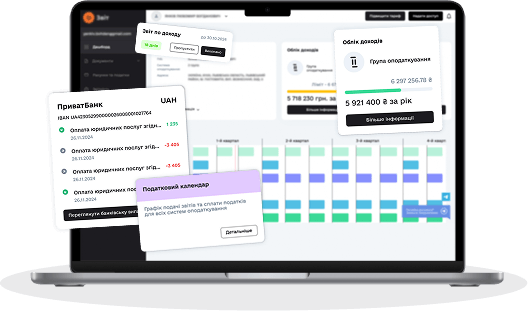
Less manual accounting for sole proprietors
Connect Vchasno.Kasa and Vchasno.Zvit to automatically record income, monitor sole proprietor limits, and prepare reporting data without duplicate entries.
Learn more