




In a barbershop, clients rarely book just a haircut. Most often, they want to visit a specific barber at a convenient time. That is why it is important for the team to work with appointments and schedules quickly and without errors.
When bookings come through Instagram, Telegram, phone calls, and a website at the same time, it becomes increasingly difficult for an administrator to properly manage the schedule. As a result, the barbershop starts losing available slots, clients, and team time.
In this article, we will look at which software to choose for a barbershop, what tasks it should handle, and why a CRM is often not enough for day-to-day operations.
Why a Barbershop Needs Client Booking and Management Software
Barbershop software helps the team work more efficiently with daily bookings, barber schedules, payments, and team workload in one place.
- For an administrator, this primarily means convenient work with the appointment calendar without constant clarifications in chats and phone calls.
- For barbers, it means quick access to their schedules, rescheduled appointments, and client bookings.
- For the owner, it is a way to quickly see appointments, team workload, and the key figures of the barbershop without constant manual checks.
When bookings, schedules, and payments work together, it becomes much easier for a barbershop to operate without scheduling conflicts and without losing time on manual process coordination.
How a Barbershop Operates Without a System — and What You Lose
In a barbershop, the schedule can change throughout the day: clients reschedule appointments, arrive late, ask to squeeze in one more haircut, or request a specific barber.
For example, on Friday after 6:00 PM, a barbershop usually has the highest number of bookings. If an administrator manually transfers clients between chats and the calendar, some slots can easily be lost or duplicated.
Or a client writes: “Book me with Artem again, like last time.” If appointment history exists only in message threads, the administrator has to manually search old messages and clarify the details.
As a result, the barbershop gradually starts losing:
- available hours in the schedule;
- repeat client bookings;
- administrator time;
- smooth team coordination;
- the ability to quickly monitor barber workload.
What Tasks Should Barbershop Software Handle?
Barbershop management software should do more than help with bookings. It is important that the system fully supports daily operations: barber schedules, clients, finances, payments, and analytics.
📲 Online Booking for a Barbershop and Barber Calendar
Online booking for a barbershop helps fill the schedule faster and reduces the number of conversations in messaging apps. Clients can choose a barber, a service, and an available time slot themselves without phone calls or lengthy messages.
When barbershop client bookings are collected in one calendar, administrators and barbers can see:
- the current schedule;
- available slots;
- rescheduled appointments;
- workload for the day or week.
As a result, the barbershop can operate more easily without scheduling conflicts and missed appointments.
👥 Barbershop Client Database
A barbershop client database is not only for storing contacts. In daily work, it is important to quickly see visit history, favourite services, and previous appointments.
For example, a client returns two months after their previous haircut. The barber can immediately see:
- what haircut was done previously;
- whether a beard service was included;
- what preferences the client mentioned;
- whether the client purchased grooming products.
Without a single client database, this information often remains buried in message threads or gets lost altogether.
📒 Barbershop Management and Finances
In a barbershop, it is important to see not only the number of bookings but also how the team is actually performing.
For example, one barber may work almost the entire week without any available slots, while another regularly has rescheduled appointments and empty gaps in the schedule. Without proper management tools, it is difficult for the owner to quickly understand how this affects team workload and barbershop profitability.
A management system helps track:
- each barber’s workload;
- average ticket size by barber;
- which hours fill up most often;
- which services clients choose most frequently;
- whether barbershop expenses are increasing.
As a result, the owner does not need to separately collect data from the cash register, bookings, and spreadsheets at the end of the day.
✂️ Barber Payroll Management
In many barbershops, payroll depends not only on a fixed salary or commission percentage. Product sales, bonuses, and additional services may also affect compensation.
For example, an administrator forgets to include styling product sales after a haircut or incorrectly calculates the commission for additional services. As a result, at the end of the month, the owner has to manually review payroll calculations for every barber.
💳 Software Cash Register (PRRO) for a Barbershop and Payments
For a barbershop, it is important that client bookings, payments, and receipts are connected.
For example, a client pays for a haircut, but the payment is not linked to the specific booking in the calendar. At the end of the day, the administrator has to manually reconcile the cash register, the schedule, and the number of completed services.
When a barbershop uses a software cash register (PRRO) for service fiscalization, a receipt is generated automatically after payment, and the data immediately becomes part of the overall business statistics.
How to Choose Software for a Barbershop: 5 Things Worth Checking
When looking for the best software for a barbershop, owners should pay attention to more than just a list of features. Even a system with excellent online booking can create extra manual work if it is inconvenient for the team to use every day.
Before making a choice, check whether:
administrators and barbers can easily work with bookings and schedules;
the system performs well with a high volume of bookings and rescheduled appointments;
bookings, the cash register, finances, and analytics work together;
the administrator can quickly update the schedule without unnecessary steps;
the system genuinely reduces the amount of manual work for the team.
For example, with Vchasno.Business, client bookings, barber schedules, payments, the software cash register (PRRO), and analytics work together in one dashboard. As a result, the team does not need to constantly switch between multiple services, manually transfer data, or separately reconcile bookings, cash register records, and finances at the end of the day.
Conclusion
The more processes a barbershop manages separately, the harder it becomes to control bookings, the team, and business profitability — even if the barbers’ schedules are fully booked several days in advance.
That is why barbershop automation is, first and foremost, a way to bring daily operations together in one place and see real business figures without constant manual reconciliation.
Modern barbershops operate more efficiently when client bookings, the client database, the cash register, analytics, and financial management work together rather than separately.
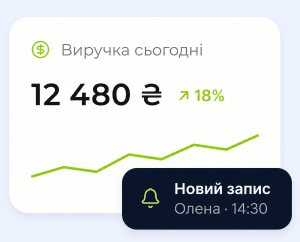
All Your Bookings, Finances, and Analytics in One Dashboard
With Vchasno.Business, client bookings, barber schedules, the software cash register (PRRO), and key business metrics work together in one dashboard — without Excel spreadsheets, notebooks, or multiple separate services.
Try now