Viber
Viber
 Telegram








According to BrightLocal, a marketing platform that has been studying online reviews for over 10 years, around 90% of customers read reviews before making a purchase. But small businesses often don’t have them. Not because customers don’t want to leave feedback, but because businesses haven’t made it part of their process.
This situation is familiar: a customer buys something, gets a receipt, and leaves. Only after the purchase do they form an opinion about the service—whether it was convenient, whether they would come back. Without feedback, the business often never finds out.
As a result, it becomes harder to spot weak points in the team’s work and understand what the customer actually experiences. In this article, we’ll look at why collecting customer reviews matters, why it’s still difficult for small businesses, and how to make it simple and consistent.
Why Businesses Don’t Collect Reviews — and Why That’s a Problem
Most of the time, it’s not about unwillingness. Reviews are simply forgotten. They’re not built into daily operations. After checkout, the cashier moves on to the next customer, and no one mentions feedback. A few minutes later, the customer leaves—and the moment is gone.
Another barrier is not knowing how to ask for a review without sounding pushy. This is especially true for small businesses—cafes, shops, services—where interaction is brief. The customer has just paid, picked up their order or coffee, and an extra request can feel out of place.
There’s also a belief that only large businesses can systematically collect reviews. Marketplaces and big chains have resources, while for small businesses it seems complicated and requires separate tools.
On top of that, reviews are often scattered across platforms: Google Maps, social media, marketplaces. Because of this, working with reviews feels like a separate, complex task.
That’s why many business owners postpone it, even though reviews help understand customer experience, identify service issues, and influence repeat purchases.
4 Reasons to Collect Customer Reviews
1️⃣ Identify problems before they go public
A customer buys something, feels dissatisfied, but says nothing. Later that evening, they leave a review on Google or social media. You only find out after others have already seen it.
When feedback comes right after the purchase, you see the issue before it becomes public. If you can contact the customer, a quick response makes a real difference. According to research by Esteban Kolsky, 72% of customers whose complaints are resolved quickly are willing to return.
Even without contact details, this still works. You see what went wrong and can fix it for future customers before the issue repeats.
2️⃣ Understand what customers actually like—and what they don’t
It often feels like you already know your customers. But without reviews, that’s just an assumption.
Comments reveal what you can’t see internally. One customer might say, “The food was great, but I had to wait too long.” Another might say, “Everything was fine, but it was cold inside.” For some, speed matters. For others, packaging or communication at checkout.
Collecting feedback after a purchase is the fastest way to understand what works well and what needs improvement.
3️⃣ Monitor service quality and staff performance
With a single location, it’s easier to notice issues. But even then, sales might look stable while service quality drops at certain times or shifts.
For example, everything runs smoothly on weekdays, but negative reviews appear on weekends. That’s a signal to look at a specific shift or team member.
When feedback is linked to a specific purchase, you can clearly see where the issue occurred: service, speed, product quality, or staff performance. It’s no longer a guess—it’s a clear signal.
4️⃣ Provide social proof for new customers
People check what others say about you—even for small purchases.
According to Nielsen, a global consumer behavior research company, around 70% of people trust online reviews.
Positive ratings reduce doubt before the first interaction.
How Businesses Usually Ask for Reviews—and Why It Doesn’t Always Work
The most common method is a QR code on a wall, door, or near the counter. It can work, but it requires extra initiative from the customer.
Another option is asking in person at checkout. This works occasionally but depends heavily on workload and human factors. In a busy flow, it’s easy to forget.
A third option is sending a thank-you message in a messenger app after the purchase. But these are often perceived as unnecessary reminders and go unanswered.
The issue isn’t that these methods are bad. The problem is they all require extra steps: remembering to ask, opening a link, and leaving a response.
How to Collect Reviews Directly from the Receipt
There is a simpler scenario—when feedback happens at the same moment as the purchase.
From the customer’s perspective, it looks like this: they pay, receive a receipt, and leave. The receipt contains a QR code. They scan it, open a page, and leave a rating in a few seconds.
⭐⭐⭐⭐⭐ 5 stars — “Great!”
⭐ 1 star — “Terrible” (and this gives you a chance to respond before the negative review goes public)
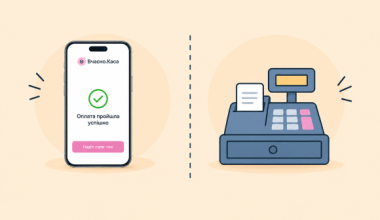
This is how reviews work in Vchasno.Kasa. The option to leave feedback is built directly into the receipt—paper or digital—and is linked to a specific purchase. For the customer, it’s easier than going to a website, opening a messenger, or remembering later.
What happens next for the business
- You see the date of purchase and the reason for a negative rating
- You get an average score in your dashboard (for example, 3.2)
- You can track trends and read specific comments
For the business, this is also a simple setup. No need to connect additional tools or pay for extra services. This feature is already included in the cost of the Vchasno.Kasa PRRO. You just start using it—and reviews are collected automatically with each receipt.
As a result, you get a clear, consistent view of your service performance every day.
Conclusion
Reviews don’t appear on their own. When collected manually, results are inconsistent. Some days the cashier remembers, the owner reminds the team. Other days, nothing happens.
When leaving a review becomes part of the purchase, the situation changes. It’s easy for customers to respond immediately after payment, and the business receives regular, clear signals: where service drops, which days or shifts have issues, and what customers highlight as strengths or weaknesses.
That’s why the most effective solutions are those where the request for feedback is built directly into the purchase process.

Collect reviews at the moment of purchase
In Vchasno.Kasa, reviews are already built into the receipt. The customer scans a QR code, leaves a rating—and you immediately see real feedback, an average score, and trends.
Try reviews