Viber
Viber
 Telegram








Content
- Introduction
- Amounts of fines for sole proprietors for the absence of cash registers in 2026
- What violations will be fined in 2026?
- Who may face RRO/PRRO fines in 2026
- How a fine is calculated: specific examples
- How the tax authorities inspect RRO/PRRO use in 2026
- How to avoid a fine for the absence of a cash register/PTR?
As of October 1, 2023, the state has resumed tax audits to ensure compliance with the rules governing the use of registrars of settlement operations (RROs). What fines may an entrepreneur face for the absence of a cash register? What regulations should be adhered to in order to circumvent these issues? We will address this in greater detail in the article.
Since August 1, 2025, full fines have applied without any reduced penalties:
- 100% of the value of goods/services — for the first violation
- 150% — for each subsequent violation
- The fine is calculated separately for each individual transaction.
The tax authorities issue fine for non-use of cash registers only after an audit has been conducted. In regard to the use of RROs, the tax authorities conduct both documentary and factual inspections. Consequently, the primary objective for any entrepreneur is to avoid such occurrences.
To achieve this, it is crucial to avoid the common mistakes that the tax authorities frequently flag. We will now discuss the most significant ones.
Amounts of fines for sole proprietors for the absence of cash registers in 2026
| Violation | Fine |
| Failure to use an RRO | 💸 100% of the value of goods sold — for the first violation; 150% — for a repeated violation |
| Failure to issue a fiscal receipt to the customer | 💸 100% of the value of goods sold — for the first violation; 150% — for a repeated violation |
| Issuing a receipt for a cash payment exceeding the limit | 💸 UAH 1,700 |
| Errors in fiscal receipt details | 💸 100% of the value of goods sold — for the first violation; 150% — for a repeated violation |
| Missing barcode for excisable goods | 💸 +UAH 5,100 in addition to the main fine listed above |
| No POS terminal at the point of sale | 💸 From UAH 1,700 to UAH 3,400 — for the first violation; from UAH 8,500 to UAH 17,000 — for a repeated violation |
| Incorrect opening or closing of a shift | 💸 UAH 510 |
| Use of an RRO after its service life has expired | 💸 100% of the sales amount — for the first violation; 150% — for a repeated violation |
| Violation of the rules for cash deposits or withdrawals | 💸 UAH 1 — for the first violation; 100% of the value of goods — for a repeated violation |
What violations will be fined in 2026?
⚠️ Fine for the absence of a cash register or its incorrect use
The Law of Ukraine “On the Use of Registrars of Settlement Operations in Trade, Public Catering and Services” (hereinafter referred to as the “Law on RROs”) stipulates which categories of entrepreneurs are required to utilize fiscal cash registers.
In accordance with the Law on RRO, the following entities and individuals may not utilize registrars of settlement operations:
- Individual entrepreneurs in the first group;
- Entrepreneurs who receive payments to IBAN details;
- Entrepreneurs who accept COD payments using Ukrposhta services (if you use Nova Poshta services, you need a RRO);
- Professionals who accept payment for services only remotely;
- Single taxpayers whose businesses are registered in villages. However, such entrepreneurs are required to maintain a record of all payment transactions, as well as a settlement book (in fact, they must also issue receipts). They frequently utilize PRROs to streamline the fiscalization process.
Therefore, in accordance with legal requirements, an entrepreneur must register a cash register prior to selling goods or providing services. It is not possible to retrospectively fiscalize sales. Therefore, due to any delays in registering a cash register, an entrepreneur may receive a fine for working without a cash register.
⚠️ Failure to issue a fiscal check to the buyer
It is the responsibility of the seller to issue a receipt following each transaction, regardless of whether the buyer requests one. In the event that the seller is an online merchant and sends the purchased goods to the buyer after receiving payment, the seller is required to include a fiscal receipt with the parcel.
Entrepreneurs who sell goods by cash on delivery through Nova Poshta are advised to use a software RRO for the most convenient fiscalization. The seller transmits electronic receipts via instant messaging platforms, email, or other convenient channels.
How to avoid forgetting a receipt or making a fiscalization mistake
✔️ automatic generation of fiscal receipts;
✔️ electronic receipt delivery to customers;
✔️ fiscalization status control;
✔️ automatic shift closing;
✔️ updates in line with legislative changes.
⚠️ Issuance of a check for cash payments over UAH 50,000 for individuals or over UAH 10,000 for legal entities
The Regulation on Cash Transactions in the National Currency in Ukraine No. 148 (the “Regulation No. 148”) restricts cash payments. A seller is fined if it issues a check for cash payments of more than UAH 50,000 to individuals and more than UAH 10,000 to legal entities.
In such instances, the buyer may opt to make the payment in a combination of cash and electronic means of payment. In this instance, the maximum amount of cash that can be paid is UAH 50,000.
⚠️ Incorrect bank details in a receipt
In the event that a barcode is not present on a receipt for excisable goods, an additional fee of UAH 5100 will be applied.
One of the most common causes of tax audits and fines is the submission of incomplete or inaccurate information on a receipt. The specific details are outlined in the Regulation on the Form and Content of Settlement Documents (hereinafter, Regulation No. 13).
In the event that an entrepreneur sells excisable goods, the receipt must also include a barcode and the UKT ZED code.
The Tax Service considers receipts with incorrect details to be unissued receipts. Accordingly, the fine for incorrect details is the same as that for failure to use the RRO.
Modern RRO providers ensure compliance with the latest legislative changes. Fiscal receipts are automatically generated with all the necessary details.
⚠️ Non-compliance with the new receipt form
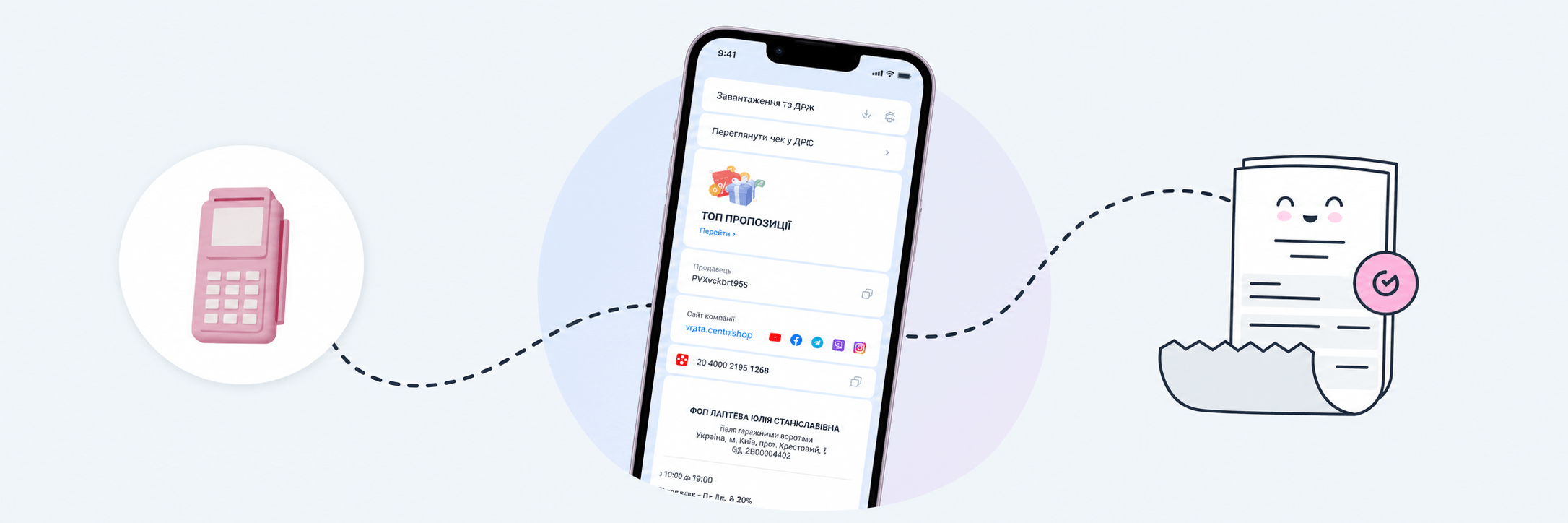
From March 1, 2025, businesses that continue to issue fiscal receipts to customers using the outdated form may be fined for improper use of cash registers. If a fiscal document is missing at least one mandatory requisite, it will be considered that the check was not issued to the customer.
According to subparagraph 1 of Article 17 of the Law of Ukraine on Cash Registers, an entrepreneur must pay:
- a fine equal to 100% of the value of the sold goods or services rendered – for the first violation.
- 150% of the value of the goods sold – for each subsequent violation.
⚠️ No POS terminal at the sales location
In accordance with Cabinet of Ministers Resolution No. 894, all entrepreneurs selling goods in localities with a population of 5,000 or more are required to use POS terminals. Failure to comply with this requirement will result in administrative liability in accordance with Article 163-15 of the Code of Administrative Offenses.
The POS terminal does not issue fiscal receipts; it only generates payment terminal receipts. Accordingly, it must be used in conjunction with a RRO or PRRO. The number of POS terminals must be at least 50% of the number of RROs.
⚠️ Incorrect opening or closing of a shift
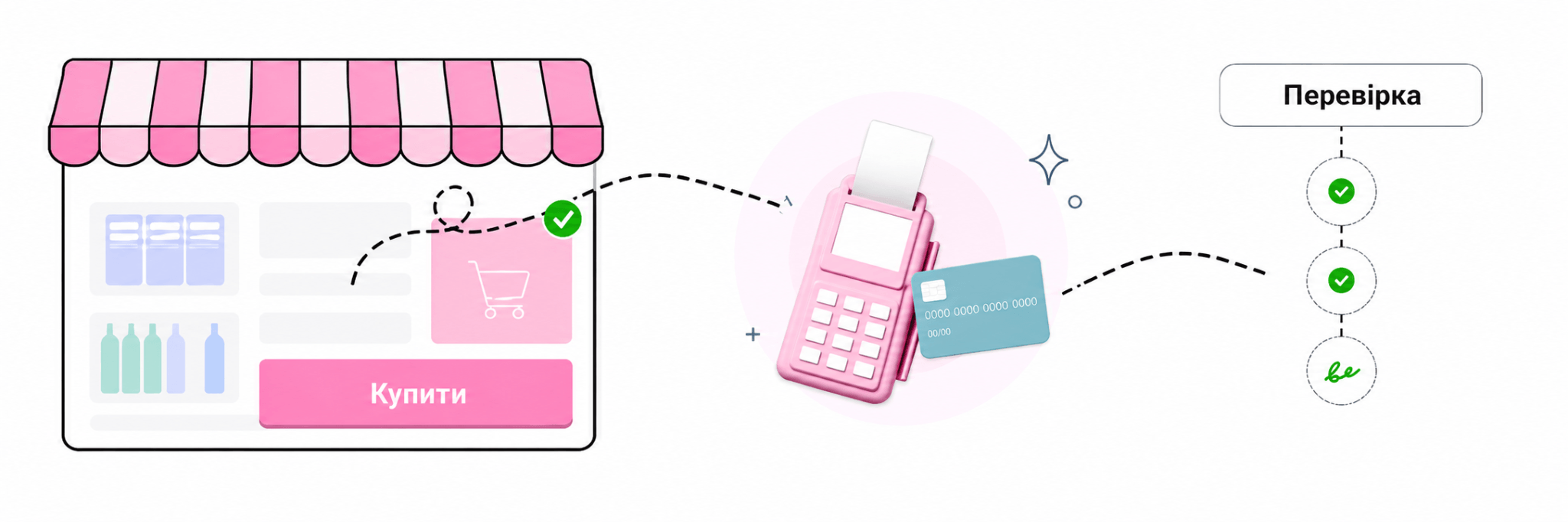
It is inadvisable for a seller to open a shift at RRO if there are no sales. A zero z-report (a report for all sales during the shift) may draw the attention of the tax authorities, potentially resulting in an audit.
Pursuant to the rules of cash discipline, the seller is required to close shifts in a timely manner, no later than 24 hours after opening. In the event that a tax audit uncovers such a violation, both the entrepreneur and the cashier will be subject to a fine.
Modern providers offer PRROs with automatic shift closing functionality. For instance, in Vchasno.Kasa, the program attempts to complete the shift within a specified time frame. Additionally, the seller will receive an email notification.
⚠️ Expired validity of cash registers
The manufacturer determines the validity period of a cash register. It provides the assurance that the fiscal cash register will function properly and retain data related to transactions for a designated duration.
The tax authorities view working with an expired RRO as tantamount to its absence at the point of sale. In the event of a violation being identified, the seller will be subject to the same fine as would be applied in the absence of a RRO. Furthermore, an administrative fine is imposed:
- A cashier who issued receipts using an expired RRO is liable to a fine of between UAH 34 and 85 for the first violation, and between UAH 85 and 170 for subsequent violations.
- An entrepreneur is subject to a fine of between UAH 85 and 170 for the first violation, and between UAH 170 and 340 for subsequent violations.
Software RROs are updated automatically. When working with them, entrepreneurs are not at risk of incurring a fine for an overdue fiscal cash register.
⚠️ Violation of the rules for depositing/receiving cash
It is crucial to correctly execute transactions unrelated to settlements when working with RROs/PRROs. In particular:
- Service deposit: The registration of the cash held in the cash register at the time of the first settlement transaction following the issuance of the z-report.
- Service withdrawal: The registration of the cash withdrawn from the cash register by the cashier.
Rules governing the conduct of such transactions are set forth in the Procedure for Registration of Settlement Transactions, No. 547.
Errors in the deposit and withdrawal of cash result in a discrepancy between the amount of cash available in the cash register and in the z-report. The tax authorities may impose a fine if they detect such a violation during a calendar year and the discrepancy between the amounts exceeds 10% of the minimum wage.
If you issue receipts after each payment, close your shift within 24 hours of opening, adhere to cash payment limits, and draw up primary documents, you will not be subject to fines for violating cash discipline.
To protect your business from risks, choose the right RRO/PRRO provider. Modern providers regularly update their software and automate cash register processes, including recording shift duration, tracking cash in the cash register, and generating z-reports. The use of such fiscal cash registers minimizes the risks associated with the human factor.
Who may face RRO/PRRO fines in 2026
Fines for violating the rules on the use of an RRO or PRRO do not apply to all entrepreneurs, but only to those business entities that are required to process payment transactions through a fiscalized cash register and fail to comply with these requirements.
You may face fines if you:
- are required to use an RRO/PRRO but process payments without one;
- process a payment transaction for less than the full amount;
- fail to issue a fiscal receipt;
- issue a receipt that does not meet mandatory requirements;
- use an RRO/PRRO in violation of the established procedure.
Fines for not using an RRO/PRRO do not apply if you:
- belong to a category exempt from the mandatory use of an RRO/PRRO;
- receive payment in a way that is not considered a payment transaction under Law No. 265;
- use an exemption provided by law.
How a fine is calculated: specific examples
Sometimes people mistakenly believe that a fine is calculated based on the store’s total turnover or daily revenue. In fact, this is not the case.
Under clause 1 of Article 17 of Law No. 265, the fine is 100% of the value of goods or services sold with a violation for the first violation, and 150% for each subsequent one. The sanction applies to a specific payment transaction, not to the entire business turnover.
| Problem | Sales Amount | First Fine | Repeated Fine |
| Sale without a receipt | UAH 20,000 | UAH 20,000 | UAH 30,000 |
| Several sales without a receipt during an inspection (UAH 5,000, UAH 8,000, and UAH 12,000) | UAH 25,000 in total | UAH 5,000 for the first transaction + UAH 12,000 (150% of UAH 8,000) + UAH 18,000 (150% of UAH 12,000) = UAH 35,000 fine | |
| Error in the mandatory receipt details for goods worth UAH 60,000 | UAH 60,000 | UAH 60,000 | UAH 90,000 |
How the tax authorities inspect RRO/PRRO use in 2026
Today, control over the use of RROs and PRROs is not limited to on-site inspections. Thanks to electronic fiscalization, the State Tax Service automatically receives a significant amount of information about payment transactions and can detect potential violations even before conducting an actual inspection.
The tax authorities can detect violations through:
- Real-time analysis of RRO/PRRO data. All fiscalized receipts are transmitted to the State Tax Service, so tax officers can see suspicious transactions, unusual interruptions in cash register operation, or missing receipts.
- Customer complaints. If a customer was not issued a receipt or received a document that does not meet the required format, they can file a complaint with the State Tax Service.
- On-site inspections. Tax officers may carry out test purchases and check whether payment transactions are processed through an RRO or PRRO.
- Comparison with data from other sources. The State Tax Service may compare information from bank acquiring systems, marketplaces, delivery services, and other sources with fiscalization data.
- Risk-based monitoring. Businesses with unusually low turnover, regular offline operation, frequent receipt cancellations, or other risky transactions are more likely to be selected for inspection.
How to avoid a fine for not using an RRO/PRRO: a business checklist
To minimize the risk of fines and be prepared for any inspection by the State Tax Service, go through this short checklist.
✔️ Make sure you understand your RRO/PRRO obligations
If you accept payments in cash, by bank card via a POS terminal, QR code, or other payment services, in most cases an RRO or PRRO is required.
✔️ Register your RRO or PRRO before you start operating
Do not postpone cash register registration. If the law requires you to use an RRO/PRRO, it must be used from the very first payment transaction.
✔️ Fiscalize every sale
All payment transactions must be processed through an RRO or PRRO, regardless of the purchase amount.
✔️ Issue a receipt to the customer
A paper or electronic receipt must be provided to the customer after each payment transaction.
✔️ Check that receipt details are correct
Make sure receipts contain all mandatory details in accordance with the current form of the payment document. Errors in certain details may also be grounds for financial penalties.
✔️ Monitor the proper operation of your RRO or PRRO
Check the cash register status, make sure receipts are correctly transmitted to the State Tax Service, and update the software on time.
✔️ Do not use an RRO after its service life has expired
If you use a traditional cash register, monitor its service life and replace the equipment on time.
✔️ Regularly check non-fiscalized receipts
After technical failures or offline operation, make sure all receipts have been successfully transmitted to the State Tax Service.
✔️ Consult a tax specialist when legislation changes
The rules for using RROs and PRROs are updated regularly, so it is worth monitoring changes or consulting specialized experts.
Don’t want to manage everything manually?
Vchasno.Kasa helps automate daily PRRO operations
Try Vchasno.KasaLegislation governing the use of RRO/PRRO is subject to change. Before making a decision, check the current legal requirements or consult a tax specialist.