




Content
- Introduction
- Why Clients Don’t Return After Their First Visit
- Why Retaining a Client Costs Less Than Acquiring a New One
- 5 Ways to Increase Repeat Appointments
- How to Tell If Your Salon Is Losing Loyal Clients
- Why Managing Your Client Base Manually Becomes Difficult
- How to Automate Client Retention
- Conclusion
Most salons are used to looking for growth through new clients: running ads, testing promotions, investing in marketing. But often the biggest losses go unnoticed — people visit once, leave happy with the service, and simply never come back. As a result, the salon keeps paying to acquire new clients, even though its most profitable growth channel is its current customer base.
In this article, we’ll look at why clients disappear after their first visit, how to increase repeat appointments, and why customer retention often brings more profit to a business than constantly investing in new advertising.
Why Clients Don’t Return After Their First Visit
In the beauty industry, clients rarely plan their next appointment right away. People postpone it, forget about it, try other specialists, or simply choose the salon that first catches their attention when the need comes up again.
For example, a client had a manicure three weeks ago. No one offered to schedule her next appointment, and she never received a reminder — so the next time, she simply booked wherever she found an available slot faster.
Most often, salons lose clients for several reasons:
- the next appointment is not booked immediately after the service;
- no one reminds the client when it’s time to come back;
- the receptionist doesn’t know who hasn’t booked in a while;
- communication effectively stops after the first visit;
- customer management remains inconsistent.
As a result, the salon gradually loses people who have already trusted the business once, even though they are the most likely to return again.
Why Retaining a Client Costs Less Than Acquiring a New One
For most salons, advertising is one of the biggest ongoing expenses. To attract a new client, businesses regularly spend money on targeted ads, Instagram promotion, Google Ads, or partner collaborations.
However, according to Harvard Business Review, acquiring a new customer can cost a business 5–25 times more than retaining an existing one.
The reason is simple: a new customer has to go through the entire trust-building journey. First, they see an ad. Then they browse the stylist’s portfolio, read reviews, compare prices, choose a salon, and only after that book an appointment. A returning client has already gone through that process.
If a specialist sees a client for a manicure every three weeks, then over the course of a year, one loyal client can bring the salon more than 15–17 visits. Losing that client means losing not just one payment, but an entire stream of future revenue.
For example:
- a new client books a hair coloring appointment through an ad;
- the salon spends money to acquire that client;
- the client is happy with the result but never comes back;
- the business effectively loses the opportunity to keep earning from that client in the future without spending more on advertising.
That’s why customer retention directly impacts salon profitability.
5 Ways to Increase Repeat Appointments
A repeat appointment happens when a client comes back for another service after a previous visit. This metric helps measure customer loyalty and the stability of a salon’s future revenue.
Clients rarely return by accident. In most cases, repeat visits are the result of consistent work with bookings, reminders, visit history, and loyalty programs. Below, we’ll look at five practical ways to increase repeat appointments at a beauty salon.
📋 Keep Track of Customer Visit History
To bring clients back, you need to understand their behavior. When did they last visit? Which services do they choose? How often do they book? At what point do they start dropping out of their regular routine?
For example, if a client usually comes in for eyebrow shaping every three weeks, the absence of a new booking may already mean that person is gradually slipping away.
🔍 Track Clients Who Stop Coming Back
Most beauty services follow a predictable repeat cycle. If a client does not book within their usual timeframe, the salon is already starting to lose them. For example:
- a haircut typically needs refreshing about once a month;
- treatment-based services are usually repeated in courses;
- some skincare procedures require ongoing maintenance visits every few weeks.
🔔 Send Repeat Appointment Reminders
Even a satisfied client may simply postpone booking and come back later — or never return at all. A timely reminder helps bring back part of your clients before they start looking for another salon.
📅 Offer the Next Appointment Right Away
One of the easiest ways to increase repeat bookings is to schedule the next visit while the client is still at the salon. For example, after the service, the receptionist can immediately offer a convenient date a few weeks ahead.
This way, the salon doesn’t lose the client between visits.
💝 Use Loyalty Programs
Retention improves when clients receive extra value from coming back regularly. The most effective options usually include:
- bonuses for repeat bookings;
- points-based loyalty programs;
- special offers for regular clients.
This approach increases not only repeat visits, but also long-term customer loyalty.
How to Tell If Your Salon Is Losing Loyal Clients
A salon may fail to notice the problem for a long time because appointments seem stable on the surface. But if new clients constantly replace those who stop returning, the business gradually starts losing part of its predictable revenue.
It’s worth paying attention if:
- most clients come in only once;
- repeat bookings start decreasing;
- it’s difficult to tell who hasn’t visited the salon in a while;
- some clients simply stop booking without any obvious reason;
- customer information mostly exists in the receptionist’s memory or scattered messages;
- the number of appointments depends primarily on advertising.
In most cases, this means the salon is losing clients right after their first visit.
Why Managing Your Client Base Manually Becomes Difficult
When a salon is still small, it may seem easy for the owner to keep track of returning clients. But as the salon’s customer base grows, manual work starts creating hidden losses.
Imagine a salon handling 150–200 appointments per week. Within just a month, it becomes almost impossible to manually track bookings, remember customer history, monitor repeat visits, and avoid losing people who have stopped returning.
When all this work relies on notebooks, Excel spreadsheets, scattered messages, and the team’s memory, mistakes begin to pile up.
As a result, the salon starts losing repeat revenue without even noticing it.
How to Automate Client Retention
Modern business management tools allow salons to manage customer retention much more accurately than manual processes. For example, you can:
- track every customer’s visit history;
- see who hasn’t booked in a while;
- launch loyalty programs;
- analyze the percentage of repeat visits;
- create personalized offers.
With Vchasno.Business, it’s easy to track how often clients come back, which services they book again, and where the salon starts losing future appointments. This allows the salon to consistently work on bringing clients back again and again.
Conclusion
For a beauty salon, it’s important to understand not only how many appointments are booked today, but also how many clients come back again. Repeat visits create the part of revenue that a business can predict with much greater confidence.
The more consistently clients return, the more predictable business growth becomes — and the less money the salon has to spend constantly acquiring new customers.
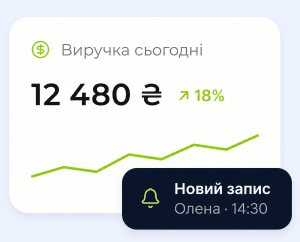
How Not to Lose Clients After Their First Visit?
With Vchasno.Business, customer records, bookings, visit history, and analytics all work together in one dashboard.
Try now