Viber
Viber
 Telegram








The supply market in Ukraine is transitioning to full digitalization. Today, large retail chains require their partners to have a fully-fledged electronic document management system in EDI services and are gradually switching to electronic consignment notes (eTTN).
Previously, these two systems operated separately from each other, creating gaps in the supply chain. Partners issued invoices, acts, and other documents for goods in EDI services, and used paper consignment notes for transportation.
In 2025, electronic consignment notes will become a logical and necessary addition to the digital ecosystem. ETTN has the same legal force as a paper consignment note, but provides reliability, transparency, and instant information exchange between all participants in the transportation process.
In this article, we will discuss how eTTN is integrated into the Vchasno digital ecosystem and what practical benefits a supplier gains from the complete automation of the supply process.
How eTTN complements the EDI system
EDI is a system for the electronic exchange of commercial documents: orders (ORDER), confirmations (ORDRSP), shipping notifications (DESADV), etc. With its help, the supplier receives an order from the network, confirms it, and notifies the network that the goods are ready for shipment. This saves time and helps avoid mistakes during the approval stage.
For a long time, the most critical stage for suppliers was the transportation of goods and their acceptance at the network’s warehouse. The supplier sent a dispatch notification (DESADV) via the EDI service, indicating the quantity of goods, items, and vehicle number. But then, when the vehicle left the warehouse, it was necessary to manually fill out a paper consignment note and delivery note. This caused delays and discrepancies in the data, which had to be reconciled.
The introduction of electronic consignment notes has automated this stage of delivery. The eTTN records the fact of transportation of goods and identifies the parties involved in the process. Digital eTTN, such as the state-accredited Vchasno.TTN service, not only allow you to track the delivery of goods, but also help carriers comply with all transport legislation. Documents are generated using current forms, and the data in them is automatically downloaded from the supplier’s accounting system.
How EDI and eTTN provide a complete document flow cycle in the supply of goods
The complete document flow cycle in supply consists of the following sequential stages:
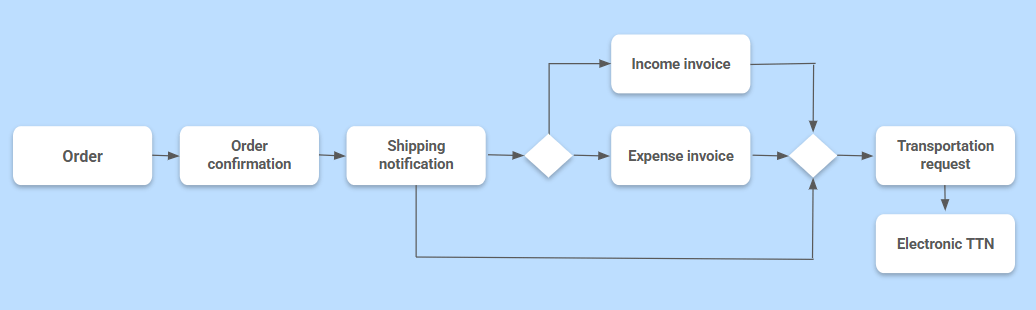
🔹Order (ORDER)
The retail chain creates an order (ORDER) in the EDI system. The order is sent to the supplier’s warehouse, where the system automatically checks the availability of goods, determines prices, and calculates payment terms. At this stage, there is no need for telephone negotiations or email coordination — the entire process is clear and transparent.
🔹Order confirmation (ORDRSP)
The supplier receives the order, checks it, and sends confirmation via EDI. The chain sees that the order has been accepted and prepares for the arrival of the goods.
🔹Shipping notification (DESADV)
At this stage, the supplier generates an end-to-end shipping notification — DESADV. It contains information about the exact quantity of goods, items, flight number, shipment date, vehicle number, and driver. All this data is automatically transferred to the network’s warehouse, where the system prepares the receiving area and informs managers about the expected arrival of the vehicle.
🔹Expense or income invoice
Based on DESADV, the EDI system generates an expense or income invoice (COMDOC_006) — depending on the document flow scheme used by the network.
This is a primary accounting document that confirms the receipt or transfer of goods and serves as the basis for accounting and tax reporting of the transaction.
The outgoing invoice is created automatically based on DESADV data — the supplier does not need to enter the information manually. The parties sign the invoice with a qualified electronic signature (QES), which gives it legal force.
🔹Electronic TTN
Based on the invoice, an eTTN is generated in the form approved by the Ministry of Community and Territorial Development of Ukraine. The eTTN contains information about:
- the date and place of compilation;
- the consignor;
- the consignee;
- the road carrier;
- the vehicle;
- the loading and unloading points.
The electronic consignment note certifies the fact of transportation of goods in accordance with all requirements of transport legislation. After signing by all parties, the electronic TTN is automatically registered in the Central Database of eTTN (CDB). The CDB is a state register that confirms the legal validity of transportation and enables verification of the document by regulatory authorities.
🔹Receipt of goods (RECADV)
When the vehicle arrives at the network warehouse, the manager checks the goods against the eTTN data. If there are no discrepancies, he signs the eTTN. The system generates a goods receipt notification (RECADV), which becomes the basis for invoicing and payment.
If the manager finds any discrepancies, the system records them and the supplier receives a notification.
Advantages of the EDI and eTTN service ecosystem for business
The combination of eTTN and EDI systems changes the entire logistics process and provides advantages for both suppliers and networks:
- Minimization of errors. Documents accompanying the shipment and transportation of goods are fully synchronized. Data from the delivery note is automatically entered into eTTN, and after the goods are received, it is entered into the network’s accounting system. At all stages of delivery, the data on the name and quantity of goods remains unchanged.
- Reconciliation of discrepancies. The entire history of the transaction is stored in a single environment with the electronic signatures of the participants. If a dispute arises about the availability of goods or the quality of delivery, there is a completely transparent database with dates, times, and electronic signatures of all parties.
- Automatic data comparison. When goods arrive at the network warehouse, the system instantly compares the quantity of goods ordered (ORDER) with the quantity shipped (DESADV), received (RECADV), and the quantity of goods in the eTTN.
- Logistics transparency. At every stage from order to acceptance, up-to-date information is available to all participants. The supplier controls the shipment of goods, the chain controls the arrival at the warehouse, and the carrier controls the safety of goods during transportation.
- Faster payments. Instant signing of the eTTN by the recipient (retail chain) confirms delivery. This significantly reduces the time between shipment and submission of documents for payment.
Vchasno ecosystem of services for goods delivery
Vchasno has developed an ecosystem of services to ensure the entire document flow cycle at all stages of goods delivery.

Vchasno.EDI
In the Vchasno.EDI service, the supplier receives orders from chains, confirms them, and generates a dispatch notification (DESADV) with all the details of the goods, vehicle, and route. The data is automatically synchronized with the supplier’s accounting system, which allows you to control all possible discrepancies at an early stage.

Vchasno.TTN
Based on the dispatch advice (DESADV), the system automatically generates an electronic TTN. The supplier does not enter the data manually; it is downloaded from the EDI system.
After that, the driver receives a notification in the mobile application about the new eTTN. No technical skills are required to start using the app. The driver can sign the eTTN in a few clicks using a digital signature or biometrics (Face ID, fingerprint). When the electronic TTN is signed by the recipient of the cargo (network manager), the system sends updates to all participants.
The Vchasno.TTN mobile app greatly simplifies the work of drivers and warehouse workers, who are often forced to sign consignment notes in the field. The app turns a smartphone or tablet into a full-fledged electronic document management tool and offers the following advantages:
| Advantages | How Vchasno.TTN works on mobile devices | Benefits for suppliers |
| No dependence on Wi-Fi networks | Drivers can view and sign eTTNs using only mobile Internet, whether at the warehouse or on the road. | Continuity of the logistics process. No downtime associated with signing. |
| Simple signing | The driver uses a qualified signature of a natural person. The company official’s electronic signature is not required. | Simplicity and speed of authorization. The carrier does not need to issue an electronic signature for each driver. |
| Legal transparency | The signed document is legally binding and is automatically recorded in the eTTN Central Database, ensuring legitimacy during traffic police inspections. | If the supplier is responsible for the transportation of goods, they are protected from fines |
| Operational control | The driver instantly receives a notification about a new waybill on their smartphone. They can view all the details of the cargo, the route, and the recipient’s data in the application | The driver delivers goods to the network’s warehouse faster. |
The combination of EDI and eTTN is a new standard of cooperation between suppliers, networks, and logistics companies. Thanks to the implementation of EDI and eTTN, suppliers can reduce administrative costs, increase delivery reliability, and demonstrate transparency of their activities to both networks and government agencies.
The sooner suppliers and logistics companies integrate both systems into a single chain, the fewer errors and time losses there will be in the supply process. Use the Vchasno ecosystem of services to optimize logistics in your company.

Automate the process of goods movement
Vchasno.EDI + Vchasno.TTN is a single digital chain of interaction between the supplier, logistics provider, and network.
Contact us