Viber
Viber
 Telegram








The process of returning goods from a chain to a supplier is one of the most resource-intensive and complex operations in retail. Chains return goods for many reasons: the expiration date is approaching, the batch is damaged, or the goods simply do not sell as expected.
Managing this process manually — using emails, phone calls, and Excel spreadsheets — is difficult, time-consuming, and prone to errors. Therefore, businesses are increasingly using EDI services to optimize product returns.
In this article, we will explain how EDI automates product returns from chains, what documents are required for this, and how this process works in the Vchasno.EDI service.
Why do chains return goods to suppliers?
The reasons for returns can vary, but most often they boil down to a few typical situations:
- Expiration date — the need to return goods that the chain did not manage to sell.
- Assortment management — returning illiquid goods to optimize warehouse space, especially on marketplaces.
- Damage to goods — discovering defects after dozens of pallets have already been accepted into the warehouse, when it is impossible to physically check each unit.
- Commercial terms — coordination of promotional activities, which sometimes requires a formal return at the old price and a new purchase at the promotional price.
Each of these cases is regulated in detail in supply contracts. In them, the parties determine under what conditions and in what quantities the chain can return goods to the supplier, who transports the goods, etc.
The return of goods requires careful documentation. Each such transaction is completed by signing a return invoice. This document is necessary for the chain to correctly calculate value added tax (VAT).
Manual returns: why it is time-consuming and expensive
The main problem with returning goods using Excel documents is the significant time and operational burden on employees on both sides.
If the supplier and the chain do not use EDI, the process usually looks like this:
- The chain manager creates a list of goods with prices and quantities that they want to return in an Excel file and sends it to the supplier by email.
- The supplier’s manager receives this file and manually checks the prices and list of goods in their accounting system. This takes hours. For example, if a chain returns a batch of household appliances, each serial number is checked.
- The Excel file is sent to the category manager, who sends it to their assistant, who checks the data and sends it to the warehouse. Usually, four or more people are involved in the return process.

The human factor, different file versions, and manual verification inevitably lead to errors. If the goods have a limited shelf life, such delays in coordinating returns become even more critical and cause financial risks.
Return automation: document chain in EDI
In EDI document flow, this process is clearly structured and has a transparent scheme:
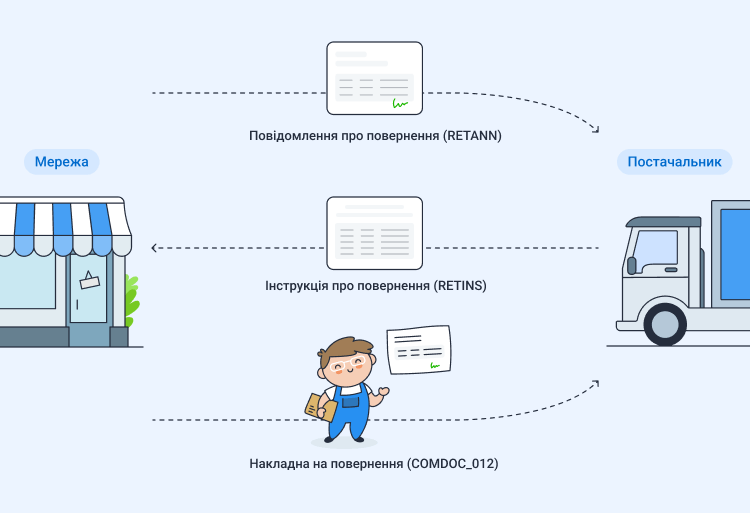
- The chain creates and sends a return notification (RETANN) to the supplier. It contains a list and quantity of goods that the chain wants to return, and the reasons for the return.
- In response, the supplier generates a return instruction (RETINS). By doing so, they confirm that they are ready to accept the goods or make adjustments.
- Based on the agreed RETINS, the network creates a return delivery note (COMDOC_012). This is a legally significant document, which is analogous to a paper return delivery note. The chain and the supplier sign it with a qualified electronic signature.
Sample return delivery note: A return delivery note is an official basis for accounting and tax records. It allows retail chains to adjust their VAT tax credits and suppliers to adjust their tax liabilities.
Returns do not always have to be linked to a single order. This is convenient for chains to keep accurate records of goods in stock and control expiration dates. However, for chains and marketplaces that work with long-term storage goods, returns can be consolidated — that is, the chain can return all surpluses to the supplier in one batch.
When product returns are not necessary: e-specification
According to Vchasno.EDI, product returns account for up to 5% of all EDI document flow.
For cases related purely to price changes (for example, to launch promotions), there is a more effective tool — e-specification. Thanks to it, the parties can legally agree on a price change without physically moving goods between warehouses. This is critically important for products with a short shelf life, where every hour spent on logistics matters.
In other cases — returns of defective or illiquid goods, etc. — the classic goods return scheme is used.
Managers do not need to manually check serial numbers, SKUs, and prices for goods — in EDI services, this happens automatically and takes only a few seconds.
How does the return of goods work in Vchasno.EDI?
The Vchasno.EDI service fully automates the process of returning goods:
- the chain creates a return notification (RETANN) in its accounting system;
- the supplier instantly sees it in Vchasno.EDI or in their system (if integration is configured);
- the supplier processes the request and sends return instructions (RETINS);
- after the goods are physically returned, the network creates a return delivery note (COMDOC_012), which both parties sign with an electronic signature.
Vchasno.EDI eliminates manual reconciliation of Excel files, errors in items or prices, and ensures compliance with all tax regulations regarding the formation of return invoices. The entire process becomes transparent and controllable for both parties.
You can learn more about the technical aspects of processing returns in our service in the Vchasno.EDI help section.
Returning goods to a supplier is a complex process. When managers and logisticians use Excel spreadsheets and email for this, it often leads to operational chaos and significant time costs. EDI services allow you to avoid these risks.
Vchasno.EDI fully automates the process of returning goods, transforming it from chaotic to clearly structured and transparent. The service’s capabilities allow you to quickly process return requests, generate the necessary legally significant documents, and sign them with electronic signatures. This eliminates manual reconciliation, minimizes errors in items and prices, and ensures compliance with tax regulations.
Use the Vchasno.EDI service to optimize logistics and accounting in your company.

Automate returns in Vchasno.EDI
Learn how to avoid mistakes, save time, and streamline your returns process.
Learn more