





Many beauty salons have loyal clients, fully booked schedules, and busy specialists, yet the owner still cannot understand how much the business is actually earning. Why? Because money gets lost in day-to-day operations: even if the salon has a CRM system, administrators continue to keep separate spreadsheets, calculate payroll manually, and book clients through messaging apps.
To keep finances under control, appointments, payments, inventory, payroll, and analytics should work within a single process without duplicating data across different spreadsheets and chats. In this article, we will look at where salons most often lose money and how to fix it.
Why a Beauty Salon Can Have Strong Revenue but Not See Its Profit
Revenue and profit are two different things. Revenue shows how much money comes into the business. Profit shows how much remains after all expenses have been paid.
For example, a salon generated UAH 300,000 in revenue during a month. However, to understand its actual profit, it is necessary to calculate separately:
- specialists’ salaries;
- rent;
- inventory purchases;
- taxes;
- advertising expenses;
- discounts;
- unfilled appointment slots;
- inventory write-offs;
- other unexpected expenses.
As a result, owners often find it difficult to understand how much profit each specialist generates, which services are truly profitable, where the salon starts losing money, and which expenses gradually increase month after month.
This happens especially often when daily processes are managed separately.
| Process | Managed In | Result |
| Client appointments | Online booking through messaging apps | Scheduling conflicts and missed appointments |
| Payroll | Excel | Calculation errors |
| Inventory | In someone’s head or tracked manually | Overspending and shortages |
| Client database | Notebook or phone notes | Loss of client history |
| Payments | Separate from appointments | Difficult profit tracking |
| Staff schedules | Different spreadsheets | Confusion with shifts |
When client appointments remain in Instagram, finances stay in Excel, and staff schedules are kept in the administrator’s notes, the owner sees separate numbers but does not see the real picture of the business.
6 Beauty Salon Management Processes That Directly Affect Profit
To see the profit of a beauty salon, it is important to monitor and record all key day-to-day processes.
💇♀️ Client Records and Appointment Database
A salon’s client database is more than just a list of contacts. It is important to be able to see:
- visit history;
- favourite services;
- average ticket size;
- cancellations;
- repeat bookings;
- visit notes.
For example, a client rescheduled her appointment through a voice message in Telegram. The administrator did not update the schedule in time, and the specialist spent an hour without a client. Situations like this may seem minor, but they gradually affect profitability.
💰 Beauty Salon Financial Management
For financial management to work properly, it is important to consistently record all money coming into and leaving the business. Some payments may be made in cash, some by card, and others through transfers. If this information remains in different places, it becomes difficult for the owner to understand how much the salon actually earned during the day.
That is why every client payment, inventory purchase, specialist salary, discount, and advertising expense should be recorded in a single management system rather than remaining in different spreadsheets or messages.
This allows the owner to see at any time:
- how much the salon earned during the day, week, or month;
- which expenses were the largest;
- which services generate the highest profit;
- whether inventory or payroll costs are increasing.
Without this type of tracking, owners are forced to rely only on the amount of money in the cash register or bank account. However, this does not show the real state of the business.
📉 Beauty Salon Expense Tracking
Every day, salons have dozens of expenses that are easy to overlook:
- hair colour products;
- gloves;
- disposable supplies;
- water and coffee for clients;
- napkins;
- delivery costs;
- small purchases.
Individually, these expenses may seem insignificant. However, over the course of a month, they can add up to a substantial amount that the owner may not even account for.
🧴 Inventory and Stock Management for Beauty Salons
Inventory tracking is not only important for large chains. Even a small salon can lose money because of overuse of supplies or unplanned purchases.
For example, a hair colouring service may include UAH 300 worth of materials in its price. However, the specialist may consistently use more colour, developer, or additional treatment products than planned. If this is not tracked, the service only appears profitable on paper.
Inventory management helps owners see:
- which products are running low;
- which items need to be purchased too often;
- where overconsumption begins;
- which services have the highest cost.
💸 Specialist Payroll Tracking
Many salons still calculate payroll manually, especially when team members work under different
- compensation models:
- fixed salary;
- commission percentage;
- bonuses;
- cosmetic product sales;
- simple chair rental arrangements;
- KPIs.
Manual calculations often lead to mistakes and constant double-checking. For example, an administrator may forget to include retail product sales or accidentally record the same payment twice.
As a result, it becomes difficult for the owner to quickly verify whether payroll has been calculated correctly, while the team regularly spends time on clarifications and recalculations.
🗓️ Online Booking and Team Scheduling
When appointments are managed within a single calendar, it becomes much easier for a salon to avoid scheduling conflicts.
The team can see:
- available time slots;
- rescheduled appointments;
- cancellations;
- specialist workload;
- client visit history.
Clients can also book appointments online without lengthy conversations in messaging apps.
Checklist: How to Know When Your Salon Needs Management Automation
Management issues usually do not become obvious because of one major mistake. Instead, they emerge through dozens of small situations that occur in day-to-day operations. At some point, the team starts spending more time reconciling records and searching for information than actually working with clients.
Check whether these situations sound familiar:
appointments are managed in several different places;
payroll is calculated manually;
the owner cannot see daily profit;
inventory records regularly do not match;
the administrator constantly rewrites client appointments manually;
clients disappear after their first visit;
there is no single appointment database;
finances must be reconciled in Excel;
it is difficult to quickly see specialist workload;
some payments do not appear in overall analytics.
If several of these points sound familiar, the problem is usually no longer individual mistakes but the way salon management is organised.
What a Beauty Salon Management System Should Look Like
A beauty salon management system should combine client appointments, finances, inventory, payroll, and analytics so the owner can see the real state of the business without manual reconciliations and multiple spreadsheets.
When management is organised efficiently:
- a client books online;
- the appointment immediately appears in the calendar;
- the service is assigned to the specialist;
- inventory is deducted automatically;
- payment is processed through the cash register;
- fiscal analytics are updated automatically.
For example, Vchasno.Business allows salons to manage client appointments, monitor team workload, work with a software cash register, accept payments, and view key business metrics in one dashboard — without Excel spreadsheets, notebooks, or multiple separate systems.
Conclusion
When appointments, expenses, inventory, payroll, and payments are stored in different places, it becomes difficult for owners to see the salon’s actual profit, even when there are plenty of clients and specialists have full schedules.
That is why beauty salon automation is not about using a “trendy service.” First and foremost, it is a way to understand what is really happening in the business every day and where the salon is losing money.
Modern salons operate more efficiently when client appointments, customer records, cash register operations, analytics, and financial management work together instead of separately.
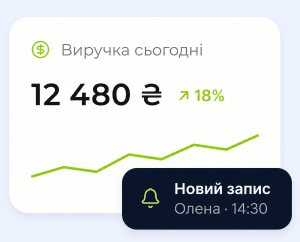
All Your Salon Analytics in One Place
With Vchasno.Business, client appointments, finances, payroll, analytics, and team management are brought together in a single dashboard—without Excel spreadsheets, notebooks, or multiple separate systems.
Try now