Telegram







 Team roles
 Hiring practices
 HR cycle
 Vacation
 Applications
 Mobile App
 For Retail Chains
 For IT Companies
Content
- Introduction
- Why Chats and Calls No Longer Scale
- Employees Expect to Resolve HR Matters from Their Smartphones
- What a Single Point of Entry for Employee Requests Looks Like
- What the Company Gets Besides Yet Another App
- How Much Time Can Be Saved with Digital HR Processes?
- Checklist: 5 Signs It’s Time to Move HR Matters from Chats to a Single System
An HR specialist’s working day often starts not with tasks, but with responding to messages in work chats. Calls, messenger messages, and emails all take up a significant part of the working day.
It becomes especially difficult when HR requests come in through several channels at once, and each one needs to be tracked separately for its status, responsible person, and outcome.
In this article, we’ll look at why it is difficult to scale HR requests through messengers and email, what employees expect from their interactions with HR, and how an employee mobile app helps move routine HR processes into a more structured digital format.
Why Chats and Calls No Longer Scale
Messengers are convenient when you need to quickly ask an HR specialist a single question. The difficulties begin when a significant share of employee requests comes through them.
Information may arrive simultaneously via Telegram, Viber, email, and personal messages. As a result:
- Requests are scattered across different channels. Something comes through Telegram, something through Viber, and something by email — making it impossible to get a complete picture.
- It becomes harder to track who is responsible for a specific request — responsibility becomes blurred.
- There is no request status. An employee sends a message and waits, while the HR specialist may not always be able to respond immediately. This leads to the repeated question, “Did you see my message?”
- Document signing depends on people rather than on a process. To get each signature, an employee has to remind the manager, find a convenient time, and check whether everything has been signed.
- The history of requests gets lost. After six months, it becomes impossible to keep track of who requested what and when.
A logical objection arises: wouldn’t it be easier simply to send a message or make a call? It is easier — as long as there are only a few requests. But when HR processes dozens of similar requests manually every day, manual processing itself becomes the bottleneck, rather than a lack of communication.
Employees Expect to Resolve HR Matters from Their Smartphones
A smartphone has long become the primary tool for handling most everyday matters — banking, delivery services, booking a doctor’s appointment. Expectations of employers are changing according to the same principle: if any routine matter can be handled from a phone, a work-related matter should be handled in the same way.
This applies not only to office employees or IT teams. Someone working in manufacturing, a store, or out in the field may also want to check their remaining vacation days or submit a request for a certificate. And they do not want to wait until they have time to call the office. Employees in any industry expect to be able to handle HR matters quickly and conveniently in the workplace.
What a Single Point of Entry for Employee Requests Looks Like
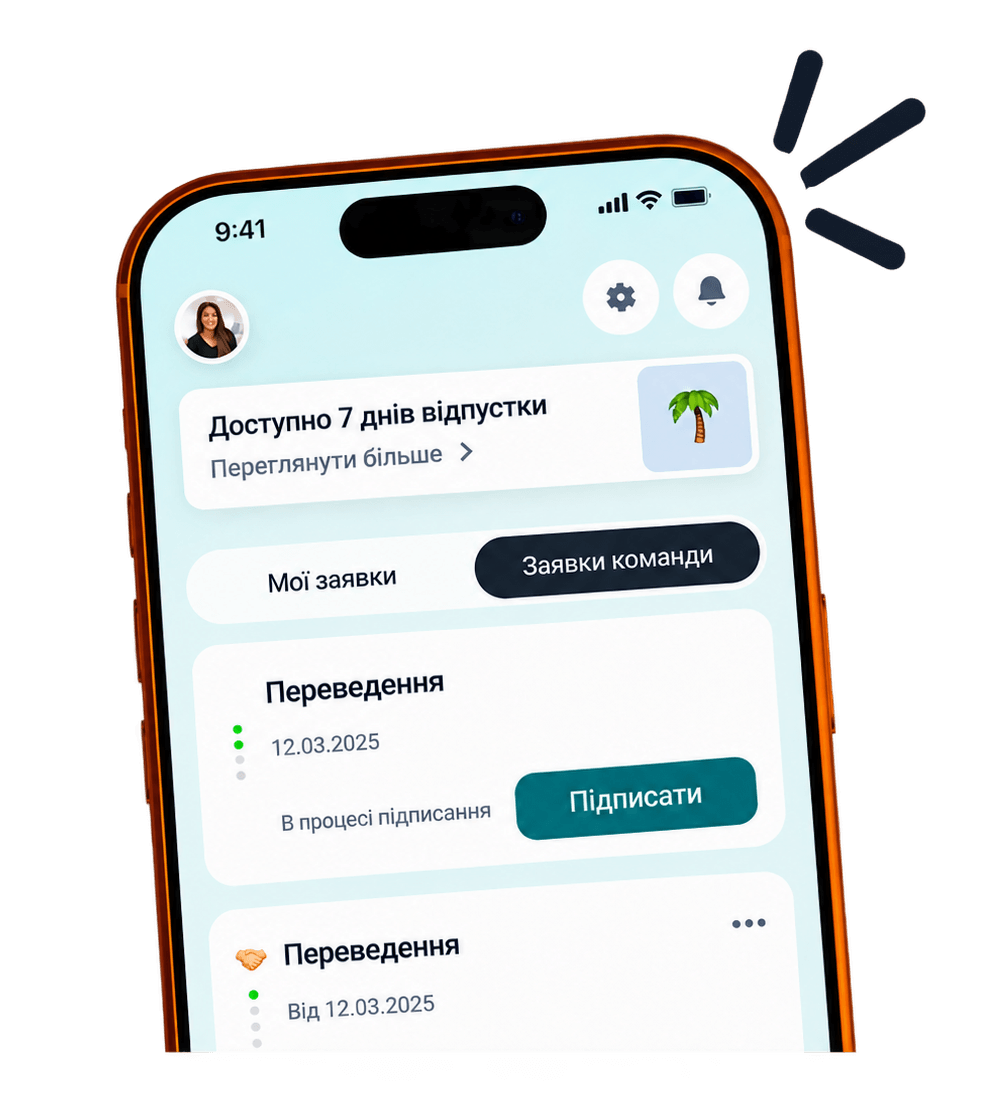
Instead of handling requests through chats, calls, and email, all requests can be submitted and processed from a smartphone using an appropriate mobile app.
Here’s how it works:
- An employee submits a request from their smartphone — for vacation, a certificate, a business trip, or any other HR matter. There is no need to message anyone personally or remember exactly whom to address the request to.
- The request is immediately assigned to the responsible employee — an HR specialist, HR manager, or another specialist, depending on the type of request.
- The document is generated automatically — the HR specialist does not need to prepare an application or order manually; they only need to confirm the action in the system.
- Approval and signing take place online — the manager receives a notification about the required signature and signs the document with one click, without reminders or paper printouts.
- The employee can see the status of their request — so there is no need to contact HR again to check whether everything has been approved.
This is exactly how the Vchasno Kadry mobile app works: HR matters that were previously handled through calls and messages across several messengers are brought together in one place — from the initial request to the completed document.
What the Company Gets Besides Yet Another App
Moving from chats to a single tool is convenient not only for HR specialists but also for employees, managers, and the business as a whole:
- employees do not need to look for HR, send a message in a chat, or wait for a response;
- HR specialists do not need to sort through dozens of channels and manually track statuses;
- managers do not need to remember what exactly they need to sign;
- the company gets a single standard for interaction with less routine work.
The Vchasno Kadry mobile app completely replaces chaotic communication with a clear process — from request to result.
How Much Time Can Be Saved with Digital HR Processes?
Digitalizing HR processes is not just about convenience.
Based on the experience of Vchasno Kadry customers, digital HR document management can save an average of 6 hours and 36 minutes of an HR specialist’s time per employee per year. For a team of 100 people, that amounts to 660 hours, or 82.5 working days.
That is time that can be spent not searching for messages, reminding people to sign documents, or answering the same questions repeatedly, but on work where HR involvement is genuinely needed.
Want to see how this could work specifically for your company?
Leave a request — we’ll show you what Vchasno Kadry can do and together identify which HR processes can be moved into a convenient digital format.
Leave request
Checklist: 5 Signs It’s Time to Move HR Matters from Chats to a Single System
If several of the points below apply to your company, your current approach may already be slowing down the HR department:
- vacation, certificate, or business trip requests arrive through different messengers and email at the same time;
- employees regularly ask the HR specialist whether they received their message;
- document signing is delayed because managers have to be reminded personally;
- it is difficult to quickly retrieve the history of who requested what and when;
- employees working outside the office — in manufacturing, warehouses, or retail locations — do not have a convenient way to submit a request.
A mobile app for HR matters is not «just another tool for HR». It is a way to improve the experience for employees, managers, and the HR department itself while also having a positive impact on the business as a whole. Vchasno Kadry helps move HR matters out of messenger chats:
✅ Employees submit requests from their smartphones — without calls or messages across three different messengers.
✅ Documents are generated automatically, while the manager can sign them with one click.
✅ Every request has a status and an assigned person, so nothing gets lost.