Telegram







 Team roles
 Hiring practices
 HR cycle
 Vacation
 Applications
 Mobile App
 For Retail Chains
 For IT Companies
Content
- Introduction
- What is annual leave, and what types are there?
- How many days of annual basic leave is an employee entitled to?
- Annual additional leave: who is eligible and how it combines with regular leave
- When an employee becomes eligible for annual leave
- Procedure for granting annual leave: what the employer must do
- Can annual leave be split into parts?
- What HR or a personnel manager should check before approving vacation time
- Common mistakes when granting annual leave
- How to simplify the process of requesting annual leave in Vchasno.Kadry
24 calendar days is the minimum duration of annual basic leave for most employees. However, in practice, employers and HR professionals face more than just the question of the number of days. It is important to correctly determine an employee’s entitlement to leave, take into account legal requirements regarding the timing of its granting, and prepare the necessary documentation.
This article summarizes the key rules for granting annual leave in 2026 and provides answers to the most common questions from employers and HR professionals.
What is annual leave, and what types are there?
Annual leave is a paid period of rest guaranteed by law, during which an employee’s job and average earnings are preserved.
The law provides for two types of annual leave:
- basic annual leave — granted to all employees who are in an employment relationship with an employer;
- additional annual leave — granted to certain categories of employees, in particular for working in hazardous or arduous conditions, for the special nature of their work, or in other cases provided for by law.
How many days of annual basic leave is an employee entitled to?
According to Article 6 of the Law of Ukraine “On Leave,” an employee is entitled to annual basic leave of at least 24 calendar days for each full year of service. The working year begins on the date the employment contract is signed.
For certain categories of employees, the law provides for an extended duration of annual basic leave. In particular, this right applies to minor employees, persons with disabilities, teaching and research staff, and others.
In 2026, during martial law, public holidays and non-working days at the national level do not apply. Therefore, all calendar days falling within the period of annual leave are included in its duration.
Even if a company designates certain holidays as non-working days through an internal decision, they are still counted as part of the vacation. For example, if August 24 is a non-working day at a company but falls during an employee’s vacation period, that day is included in the total number of vacation days.
Annual additional leave: who is eligible and how it combines with regular leave
In addition to regular vacation, certain employees may be entitled to additional annual leave.
The most common grounds for granting such leave are:
- work in hazardous or arduous conditions;
- the special nature of the work;
- other cases provided for by law.
The duration of additional leave depends on the grounds for granting it, working conditions, and the actual time worked. Time spent working under such conditions and periods of annual leave are counted toward the relevant length of service.
Additional leave is granted in addition to the basic annual leave, not in lieu of it. Therefore, an employee may be entitled to both types of leave at the same time. For HR record-keeping purposes, it is important to track them separately, as each type has its own rules regarding granting, carrying over, and compensating for leave.
When an employee becomes eligible for annual leave
As a general rule, during the first year of employment, an employee becomes eligible for full annual leave after six months of continuous service with the employer.
If an employee wishes to take leave earlier, it may be granted on a pro-rata basis based on the time worked. In other words, the duration of the leave is calculated based on how many months the employee has already worked.
Working part-time (part-day or part-week) does not reduce the duration of annual leave.
Procedure for granting annual leave: what the employer must do
The procedure for granting leave is governed by the Labor Code of Ukraine and the Law of Ukraine “On Leave.” To process leave correctly, an employer must follow several mandatory steps:
1. Draw up and approve a vacation schedule, taking into account operational needs and the rights of employees to take vacation at a time convenient for them.
Special attention should be given to employees who, in accordance with Article 10 of the Law of Ukraine “On Vacations,” have the right to take their annual vacation at a time convenient for them. These categories include:
- employees under the age of 18;
- people with disabilities;
- pregnant women;
- women before, during, or after maternity leave;
- women who have two or more children under the age of 15 or a child with a disability;
- single mothers and single fathers;
- spouses (husbands or wives) of military personnel;
- veterans of labor;
- war veterans;
- persons with the status of participants in the Revolution of Dignity.
2. Notify the employee in writing of the start date of the leave no later than 2 weeks in advance.
3. Obtain a request (if necessary) if the leave is granted outside the approved schedule.
4. Issue an order granting the leave, specifying its type, duration, dates, and the work year for which it is granted.
The order must specify:
- the type of leave;
- the start and end dates;
- the duration;
- the work year for which it is granted.
Specifying the work year is one of the most important requirements. Annual leave is granted for the completed work year, which is calculated from the date the employment contract was signed, not from the beginning of the calendar year.
After the order is signed, the employee must be made aware of its contents.
5. Record the leave in personnel records and reflect it in the time sheet.
Can annual leave be split into parts?
The law allows employees to take their annual leave not only as a single continuous period but also to split it into parts. However, there is an important condition: one of the parts of the basic annual leave must be at least 14 calendar days.
What HR or a personnel manager should check before approving vacation time
Before processing a leave request, the HR specialist must verify three key areas: the employee’s eligibility for leave, the availability of the necessary documents, and compliance with established deadlines.
The employee’s eligibility for leave
- Has the employee completed 6 months of continuous service to be eligible for full annual leave in their first year of employment?
- If not, does the employee belong to a category eligible for leave earlier?
- Does the employee have enough unused vacation days?
- Does the planned duration of the leave correspond to the available balance of days?
Documents and vacation schedule
- Do the vacation dates align with the approved schedule?
- If the leave is granted outside the schedule — has the employer’s approval been obtained?
- Is an employee’s request required, and has it been submitted properly?
- Has the employee been notified of the start of annual leave no later than 2 weeks in advance?
- Has a draft order granting the leave been prepared?
Financial and organizational issues
- Has the average salary for vacation pay been calculated correctly?
- Have vacation pay accruals and payments been processed on time?
- Has the order granting vacation been approved and signed?
- Has the handover of the employee’s current tasks for the period of their absence been organized (if necessary)?
Common mistakes when granting annual leave
Most often, problems arise due to improper maintenance of HR records, missed deadlines, or errors in calculations. Among the most common mistakes are:
| Mistake | What to Consider |
| No leave schedule | This is a mandatory document that determines the order in which employees take leave. The employer must approve a leave schedule for each calendar year, usually by January 5, and familiarize employees with it. |
| Late notification of the employee | The employee must be notified in writing of the annual leave start date no later than two weeks in advance (Article 10 of the Law of Ukraine “On Leave”). |
| Ignoring a written application | Leave must be formalized by an employer’s order issued on the basis of the employee’s written application, unless the leave is taken strictly according to the approved schedule. |
| Failure to meet leave pay deadlines | Leave pay must be paid to the employee no later than three days before the leave begins (Article 115 of the Labour Code of Ukraine). |
| Postponing payment at the employee’s request | Asking an employee to submit a request for leave pay to be paid after the statutory deadline is a violation of labour legislation. |
| Calculating length of service and periods | Annual leave is granted for the working year, which begins on the date the employment agreement is concluded, rather than for the calendar year. Leave is granted in calendar days, excluding public holidays and non-working days where applicable. |
| Confusing different types of leave | Basic annual, additional, and social leave have different legal grounds and procedures. They cannot be granted for the same dates, as the law does not allow an employee to take two types of leave simultaneously. |
| Granting unpaid leave | Unpaid leave is regulated by separate provisions of the law. The employer has no right to force an employee to take such leave. |
How to simplify the process of requesting annual leave in Vchasno.Kadry
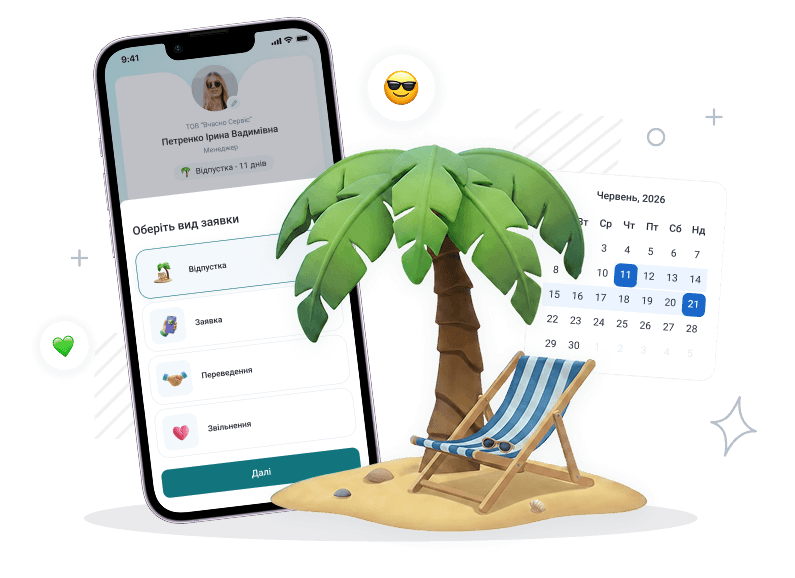
Processing vacation requests often requires a significant amount of time to prepare documents, obtain approvals, and track remaining vacation days. At “Vchasno.Kadry,” this process is fully automated and handled electronically.
he service allows employees to submit vacation requests from their smartphones, approve documents online, automatically generate requests and orders, and track remaining unused vacation days. Additionally, the company can customize approval workflows and request submission rules to align with its internal processes.
As a result, HR professionals spend less time on administrative tasks, and the vacation approval process becomes transparent and manageable.
Manage vacation time in Vchasno.Kadry
Submit requests, approve documents, track remaining vacation days, and maintain a vacation schedule — all in one service.
Learn More