Viber
Viber
 Telegram










Results of implementation
The gradual transition to electronic document management has allowed the company to scale the use of digital signatures far beyond the scope of individual financial or accounting processes.


Today, digital signatures are used not only for external document management. Vacation requests, business trip documents, internal orders, occupational safety documents, and transfer records for inventory between warehouses all go through the digital signature process.
Obtaining a Vchasno QES has also become part of the onboarding process: new employees register for a key at the start of their employment if it is required for their duties.
How the company moved to electronic document management
The transition to digital document management at “Agrobudivny Alliance Astra” began even before the large-scale implementation of Vchasno. One of the initial catalysts was the company’s collaboration with large agricultural holdings that operate farms spread across various regions of Ukraine.
For such companies, paper-based document management created additional challenges: documents had to be collected from different parts of the country, transferred between offices and contractors, and then tracked to ensure the return of signed originals.
The pandemic and the shift of some employees to remote work further intensified the need for digital solutions. The company began gradually adopting various electronic document management tools and monitoring solutions available on the market.
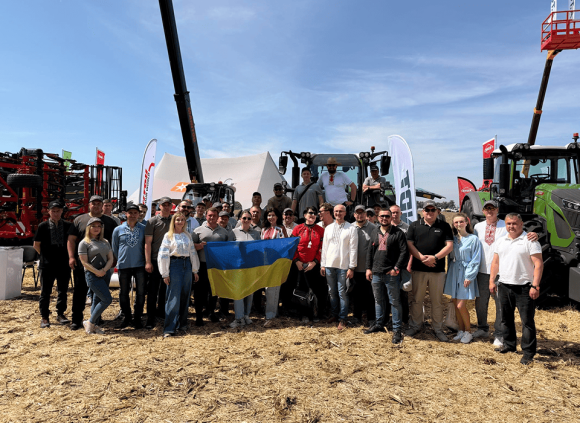
In the process, it became clear that individual tools were insufficient: the business needed a solution that could be scaled to accommodate various processes and teams. It was during this period that the company turned its attention to Vchasno.
However, the large-scale transition did not happen overnight. For the first six months, Vchasno was primarily used by teams for whom electronic document management was essential for their daily work — in particular, finance professionals who interacted with banks and leasing companies. Gradually, employees from other departments began using the system.
What problem needed to be solved?
Before switching to electronic document management, the lifecycle of a single document included: printing, signing, stamping, scanning, sending it to the counterparty, and entering the information into the registry.
After that, it was still necessary to verify whether the counterparty had received the document, signed it, and returned the original.
This process was particularly challenging for a company with a regional structure.
For example, warehouses might ship dozens of consignments of goods to different regions every day. Acceptance and transfer acts and other documents accompany these transactions, but the paper originals might remain at the receiving desk, get lost among other documents, or be waiting to be returned to the office.
This created an additional burden for personnel responsible for inventory and employees in charge of document management.
A separate challenge was tracking “outstanding” originals. Designated employees had to monitor registries and determine which documents had not yet been returned by counterparties.
The transition to electronic document management allowed the company to move documents to a digital environment and establish a new workflow for handling them — from creation and approval to signing and monitoring compliance.
 An important part of this transition was the qualified electronic signature (QES), which enabled employees to sign documents without having to refer back to the paper originals.
How “Astra Agricultural Construction Alliance” implemented QES
The company did not attempt to switch its entire staff to electronic document management all at once. The transition began with preparing employees for the new way of working: they needed to create accounts, obtain digital signatures, configure access permissions, and learn how to use the new tool.
To help the team adapt, the company conducted training sessions. Employees were shown not only the technical aspects of working with Vchasno, but also the practical results achieved by their colleagues: how many documents they had already processed in the system and how this simplified their work.
At the same time, the company gradually expanded the list of documents that needed to be signed electronically.
First, paper vacation requests were replaced with electronic ones. Then, documents related to business trips, internal orders, occupational safety documents, and transfer records for inventory between warehouses were added to Vchasno.
Thus, the electronic signature gradually evolved from a standalone tool for the accounting department into an integral part of the daily work of most employees. Today, over 95% of the company’s employees have a digital signature certificate and use the electronic document management system.
Digital signature as part of onboarding
The company decided not to stop at simply transitioning current employees to electronic document management.
Obtaining an electronic signature key and access to Vchasno has gradually become one of the first steps in onboarding a new employee. Along with a company laptop or car, an employee also receives an electronic signature key if it is necessary for their work.
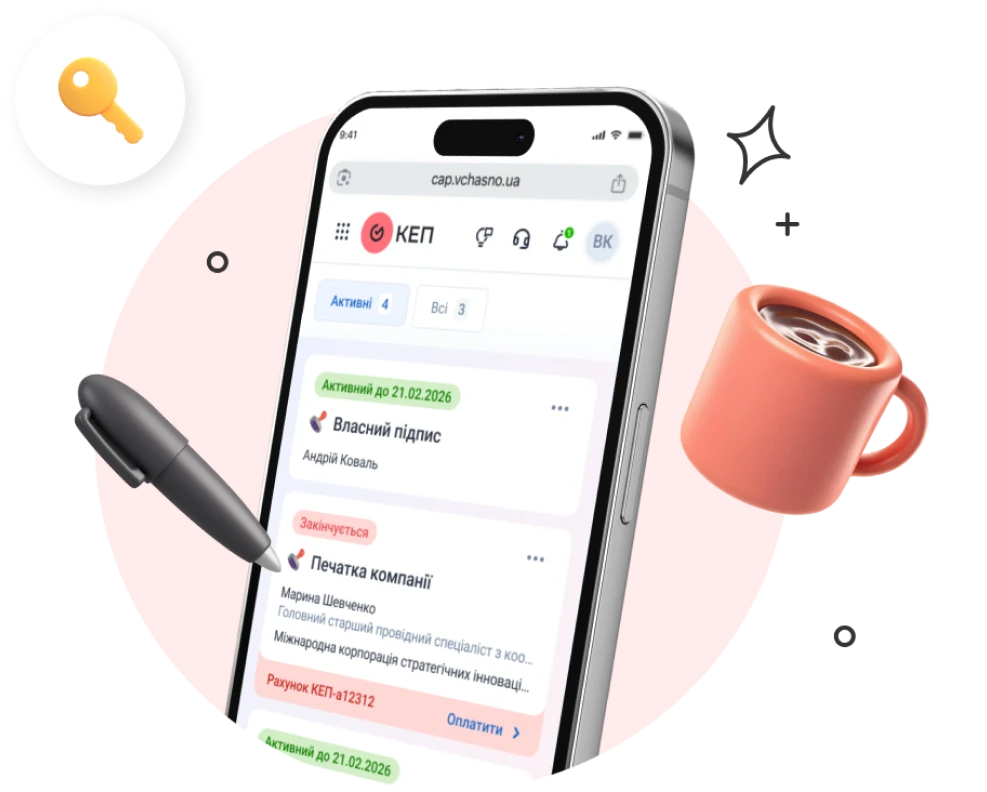
Employees themselves also note the convenience of this system. You can sign a document with just a few taps in the app:
Using the Vchasno QES app is very convenient. A notification pops up: one tap—and the document you need to sign opens via Face ID. A second tap—and the document is already signed, again via Face ID.
How external document flow has changed
 Even if a counterparty does not use Vchasno, the company can send documents to them for signature via email. This has made it possible to gradually transition external document flow to a digital format without requiring all partners to be connected at the same time.
At the same time, legal and administrative processes have also been adapted to the new format: the ability to work with electronic document management is taken into account during the negotiation and drafting of contracts.
Automated control of signed documents
The next stage of digitization was the integration of Vchasno with the company’s accounting system.
It automatically checks for signed documents and removes them from the debt registry once the originals are on file. As a result, the employees in charge do not need to constantly check the status of each document manually.
If a counterparty has not signed a document, the company can also receive reminders. For example, for documents that have remained unsigned for a certain period, the responsible employees receive a notification that they need to contact the counterparty.
As a result, document workflow management has become partially automated: instead of constantly checking the registers, employees can focus on the documents that truly require their attention.
The integration we’ve built between the accounting system and ‘Vchasno’ automatically checks for signed documents and removes outstanding items from the registry. Therefore, the responsible parties don’t even need to track this themselves.
Who works with Vchasno?
 Today, electronic document management spans various departments within the company.
Sales managers and document management administrators handle the largest volume of documents. They work with invoices, reports, expense documents, and other documents related to the sale of equipment and services.
For example, in the spare parts department, about 50 managers in various regions handle documents: they generate invoices and expense documents, and receive and sign documents from contractors. And thanks to electronic signing with Vchasno QES, this happens without delays.
The administrative department, which handles procurement, and the accounting department also use the electronic document management system for internal documents, HR processes, and travel expense reimbursement. Documents are conveniently signed using Vchasno QES keys — in just a few clicks and without switching between different services.
In total, approximately 5,000 documents pass through Vchasno each month.
What has changed for the team
The transition to electronic digital signatures has changed not only the way documents are signed, but also the very logic of working with them.
Previously, a document could take weeks to physically reach a counterparty. After switching to electronic document management, it can be signed much faster.
At the same time, the company eliminated some of the associated processes: monitoring the physical movement of originals, maintaining debt ledgers, searching for documents, and sending constant reminders to counterparties.
Electronic approval workflows also help managers work with documents regardless of their location.
For example, the CEO can sign documents according to a configured workflow, where the document reaches them only after passing through the necessary approvals. If the manager is on a business trip or cannot sign the document in person, delegation to responsible employees can be configured.
This is especially important for companies where a delay in signing a report or other document could postpone payment, the transfer of equipment, or another transaction. In a paper-based process, such a situation could arise simply because the required signatory is not in the office.
The main project result
For “Agrobudivny Alliance Astra,” the transition to the Electronic Signature Certificate (QES) was more than just replacing a paper signature with an electronic one.
The company has gradually digitized its external document flow with clients and suppliers, internal HR processes, business trips, orders, occupational safety documents, and warehouse operations.
If you have 50 or more documents per month and your employees work in different locations, an electronic signature already makes sense. And the larger the volume of documents, the more significant the time savings.
As a result, electronic document management has become part of the company’s daily operations — from onboarding new employees to interacting with business partners and internally approving documents.
| Before the implementation of the electronic signature | After the implementation of the electronic signature |
| The process of submitting and approving documents could take up to a week | Documents can be signed and approved within 1 hour |
| It was necessary to manually monitor the return of the originals | The integration automatically removes signed documents from the registry and sends reminders about unsigned ones |
| Paper applications and documents for vacation, business trips, orders, etc. | 95%+ of employees have a digital signature and handle documents electronically |
| Documents were physically transferred between offices and regions | ~5,000 documents are processed through Vchasno every month |
| To sign the document, it was necessary to go through the entire paper-based process | In the mobile app, you can sign a document in just two taps using Face ID |
Plans for further document workflow automation
Among our future plans, we are considering implementing Vchasno Kadry as well as using AI-powered document recognition. This will allow us to expand document workflow automation and make synchronization with the accounting system even more convenient and efficient.
Get more information about Vchasno
Contact us! Learn how to quickly implement e-document workflow in your company and reduce costs and team time for documents processing.