Viber
Viber
 Telegram







Content
In large companies, the problem is rarely a lack of systems and tools. Usually, EDM, CRM, ERP, logistics, and HR tools are already in place, but the process between them still breaks.
A deal is already closed in the CRM, an order is created in the ERP, but documents are still being approved; delivery is completed, but the consignment note is not signed; the finance team is waiting for documents to close the period.
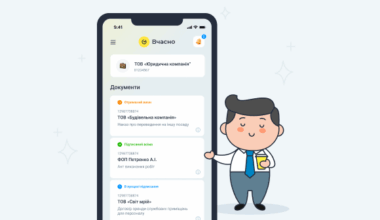
These gaps are exactly where businesses lose time, money, and control. That is why the next step after digitizing separate areas is to connect related processes into a single environment, where documents, signatures, logistics, and HR processes work as one controlled process. This is how the Vchasno service ecosystem is built.
Briefly: what the Vchasno service ecosystem provides
An ecosystem approach becomes relevant when electronic document management alone is no longer enough. Its value lies in the fact that documents, signatures, data exchange, logistics, and HR actions do not operate separately, but within one process.
For a business, this means:
- fewer manual transfers between systems
- fewer delays in approvals and signing
- transparent statuses for all participants
- faster completion of operations
- less dependence on manual control
One business process → one digital environment: how it works in key business processes
The result of this approach is clearly visible in key processes: procurement, sales, logistics, and HR operations.
📦 Procurement and supply
In procurement, each order goes through several stages: order → shipment → documents → signing → accounting. The higher the volume, the more noticeable the delays between these stages.
Gaps usually occur between steps: the order already exists, but documents are missing; documents are ready, but signing is delayed; documents are signed, but not reflected in accounting. These delays lead to loss of time, money, and control.
One illustrative example is the integration of Vchasno services into the Rozetka marketplace processes. Before implementation, work with suppliers was partially automated, but primary document processing remained slow: more than 50 minutes and 10 people per 100 orders.
After implementing Vchasno:
- about 2,000 suppliers work through Vchasno
- processing one order takes around 3 minutes
- about 250,000 documents are processed automatically every month
These results became possible due to automation of interaction between the marketplace and suppliers — from order data transfer to the exchange of primary documents.
Legally significant documents (invoices, acts, delivery notes) are created and transferred through Vchasno.EDM and signed using QES without delays or manual handling.
At the same time, Vchasno.EDI enables the exchange of structured data about orders and deliveries, allowing partners to receive information immediately after operations are created.
As a result, the procurement process does not break: order data is transferred automatically, documents are created and signed without manual actions, and partners receive them within one process.
📈 Sales and partner operations
In large companies, the sales process usually starts in CRM or ERP: a manager creates a deal, agrees on terms with the client, and starts document preparation. This is where delays often occur — documents are transferred manually, approvals take longer, and signing depends on whether all participants received the file on time.
When CRM or ERP is integrated with Vchasno services, documents are created automatically based on deal data and immediately move through a predefined approval flow:
- a contract or invoice is generated in Vchasno.EDM
- the document is automatically assigned to the responsible manager or supervisor
- approval and signing take place through Vchasno.QES without manual file transfer
- order data can be shared with partners through Vchasno.EDI
As a result, documents stop being a separate manual step that slows down sales: approvals follow a defined sequence, signing does not require manual control, and partners receive documents and data without delays.
🚚 Logistics and consignment notes
In logistics, a shipment is considered complete only after the consignment note is signed. Until all parties sign it, payments may be delayed, and accounting has to wait for confirmation.
Example: Ekol Logistics, an international logistics company with more than 70,000 shipments per year.
Before implementing electronic solutions, the process was partially digital but still fragmented: documents were created in systems, but then transferred and signed separately.
Ekol Logistics integrated Vchasno.EDM into work with clients and carriers to move document flow into one environment, and then started implementing Vchasno.eTTN for transportation digitization.
After that:
- 97% of shipments are processed electronically
- more than 1,000 carriers work in the system
- documents are created and transferred automatically between participants
With Vchasno.eTTN, Vchasno.QES, and Vchasno.EDM working together, documents are created and shared without manual file transfer or delivery tracking. Shipments are closed immediately after completion, and financial operations no longer depend on paper documents.
👥 HR processes
HR processes are often only partially automated: documents are created quickly, but manual steps remain — signing, transferring, and tracking statuses.
With Vchasno services, all actions happen in one environment:
- in Vchasno.Kadry, an employee creates a request or HR document
- in Vchasno.QES, the document is signed immediately
- in the secure electronic archive, the document is stored and available to authorized employees
In procurement, sales, logistics, and HR, different tools work together as a single system.
How HR document digitization helped Bayadera Group speed up approvals and reduce HR workload
What role each service plays in the Vchasno ecosystem
Each service within the ecosystem is responsible for a separate part of document-related work, but together they form a single controlled process.
 Vchasno.EDM — creation, approval, and exchange of legally significant documents: contracts, acts, invoices, and delivery notes.
 Vchasno.QES — document signing across all scenarios: from contracts to HR and logistics documents.
 Vchasno.EDI — exchange of structured data with partners: orders, deliveries, and related documents.
 Vchasno.TTN — creation and signing of electronic consignment notes in logistics operations.
 Vchasno.Kadry — creation and approval of HR documents in a digital format.
Individually, each service solves its own task. Together, they provide a controlled end-to-end process for the business.
One business process end-to-end: without an ecosystem vs. with the Vchasno ecosystem
To see the difference between using separate tools and working within a single ecosystem, it is worth comparing how the same business process flows in different operating models.
| Process stage | Without an ecosystem | With the Vchasno ecosystem💛 |
| Order / process start | Data is entered separately into CRM or an accounting system | Data immediately forms the basis for documents without duplication |
| Document creation | Documents are created manually or in another system | Documents are created automatically based on process data (Vchasno.EDI → Vchasno.EDM) |
| Document transfer | Sent via email, messengers, or different systems | Documents are already in the system — no need to send them |
| Approval | Happens through communication or separate tools | Approval takes place within the process, according to predefined workflows |
| Signing | A separate step: you need to find the signer, remind them, and follow up | Signing (Vchasno.QES) is built into the process — no additional actions required |
| Status tracking | Needs to be checked manually: who signed, where the document is | Status is visible in real time for all participants |
| Logistics (consignment notes) | Documents return with delays, dependence on paper | Electronic consignment note (Vchasno.eTTN) is signed immediately within the process, without delays |
| Financial accounting | Documents need to be searched for or waited on before closing the period | Documents are immediately available for accounting, without delays |
| HR actions (if applicable) | A separate process, not connected to others | HR (Vchasno.Kadry) works in the same environment |
| Storage | Documents are stored in different places or systems | A single electronic archive with a full history of actions |
| Process management | Control through people: reminders, checks, clarifications | Control through the system: transparent logic and statuses |
| Business impact | Payment delays, manual work, audit risks, loss of time | Predictable timelines, less manual work, control, and scalability |
Without an ecosystem, companies often compensate for weak connections between systems with people: reminders, checks, and manual control. With an ecosystem approach, part of this workload is transferred into the system’s process logic.
Conclusion
For large businesses, the question is no longer about choosing a separate service for documents, signatures, or logistics. What matters is whether these elements work as a single process without manual gaps between systems.
This is exactly where the value of the Vchasno ecosystem lies. The company does not simply move documents into a digital format — it connects all related actions into one process, where data, documents, signing, and storage work together without manual transitions between stages.
As a result, nothing gets lost in the workflow. Everything moves consistently and without delays, and the team does not spend time on manual data transfer and status checks.

Consolidate your business processes in Vchasno
Documents, signatures, logistics, HR — transform disparate tools into a single, manageable business system.
Order a consultation